War relies on more than ammunition and drones. Sometimes, it demands saints.
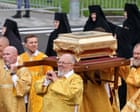
The Russian Orthodox Church recently dispatched a piece of a medieval prince's hand to troops fighting in Ukraine. It sounds like a bizarre plot twist from a historical fiction novel, but it's happening right now. A reliquary carrying a fragment of Dmitry Donskoy's right hand was shipped to Russian-occupied eastern Ukraine to "spiritually strengthen" soldiers and secure a battlefield win.
If you're wondering how a 14th-century prince fits into modern trench warfare, you aren't alone. The institutional church in Moscow has spent years transforming state aggression into a holy crusade. Patriarch Kirill and local metropolitans keep pushing the narrative that troops are fighting a sacred battle. Transporting historical body parts directly to the frontline takes that ideology to a physical extreme.
Who Was Dmitry Donskoy and Why Dig Him Up Now?
Dmitry Donskoy is a heavyweight figure in Russian nationalist history. Back in 1380, he led a united Russian army to victory against the Mongolian Golden Horde at the Battle of Kulikovo. That victory cemented his legacy as a defender of the Russian land.
His physical remains spent centuries resting inside the Cathedral of the Archangel within the Moscow Kremlin. But church authorities broke open his tomb during restoration work, pulling out his relics for public display and wartime deployment. Vladimir Putin himself attended the unearthing ceremony.
Critics and independent historians point out that opening up a centuries-old tomb breaks traditional religious protocol. Donskoy was canonized back in 1988, yet the church left his resting place untouched for decades. Historians tracking the conflict note that leadership in Moscow simply ran out of conventional morale-boosting ideas. As the war grinds on with staggering casualties, church elites needed a dramatic gesture to prove their loyalty to the Kremlin's objectives.
The Weaponization of Holy Relics in Modern Conflicts
This isn't a standalone stunt. Earlier, relics belonging to Alexander Nevsky—another medieval military hero turned saint—were carted out to Russian military units.
The strategy relies on a potent psychological trick. By linking modern soldiers to medieval warriors who supposedly farded off foreign invaders, state media and church officials frame current territorial expansion as an existential defense. It's a neat way to erase the reality of an unprovoked invasion and replace it with historical destiny.
When the reliquary arrived at the Savur-Mohyla war memorial in the occupied Donetsk region, local church leaders held prayer services alongside military commanders. Soldiers and civilians were told that the physical presence of Donskoy's hand would help them mobilize inner strength.
What This Tells Us About the State-Church Alliance
You don't need a degree in theology to see how tight the knot has become between the Kremlin and the Moscow Patriarchate. Since the full-scale invasion kicked off, priests have flooded into occupied territories, blessing weapons and handing out icons. Parishes across Russia face heavy pressure to integrate prayers for military victory into standard liturgies.
When spiritual institutions start digging up centuries-old bones to feed a political war machine, religion stops looking like a refuge. It becomes a recruiting poster.
The frontline isn't shifting because of medieval relics. Heavy artillery, logistics, and drone technology dictate the brutal math of this war. Yet the dispatch of Donskoy’s hand shows a regime desperate to wrap its military failures in the heavy velvet of historical myth.
Take a close look at how authoritarian power structures use the dead to control the living. History gets weaponized, saints get repurposed as mascots, and theology turns into state propaganda.