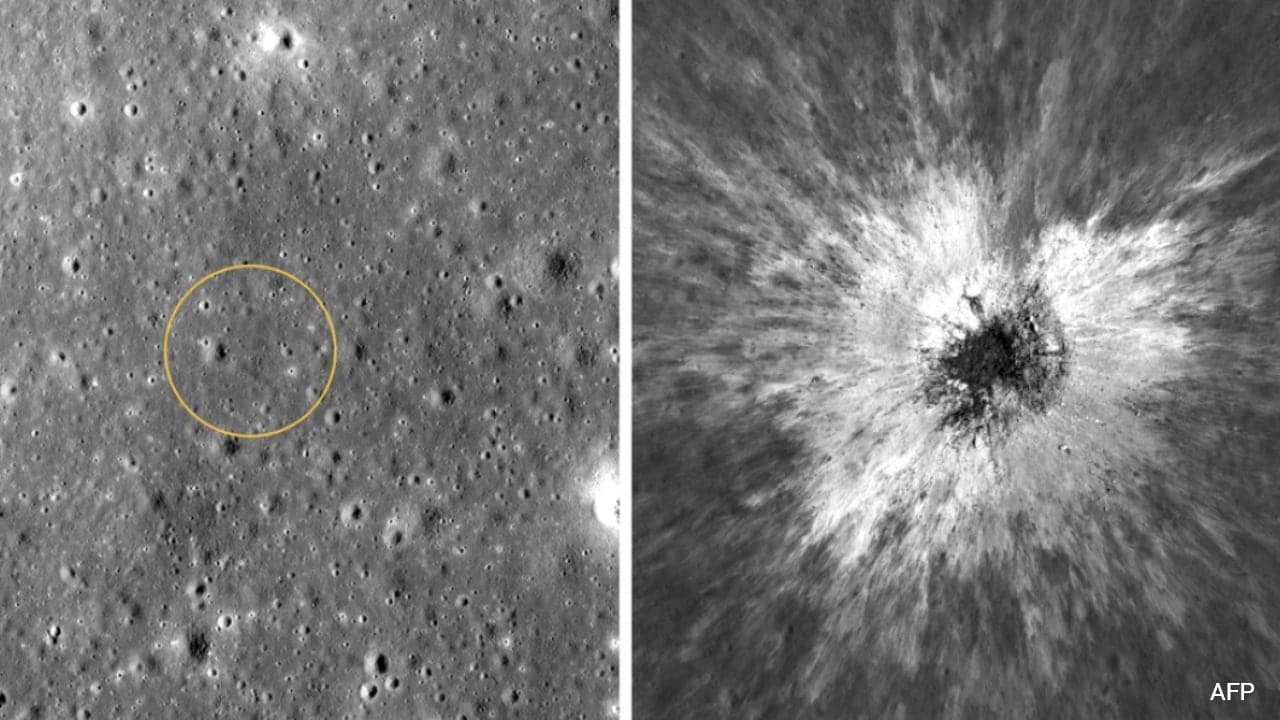
A six-story building slammed into the lunar near side in May 2024. Nobody on Earth noticed. No ground telescope flashed red. No space-weather monitor blinked.
It took until August 2025 for human eyes at NASA to sift through the data backlog from the Lunar Reconnaissance Orbiter and spot the scar. Now published in Science Advances, researchers confirm the McGetchin crater spans 728 feet across and plunges 141 feet deep.
Forget permanent Apollo footprints. The moon isn't a museum glass case. It's a shooting gallery.
What the Data Actually Tells Us
The numbers look tidy on paper. A 222-meter wide hole. Ejecta blanketing 100 kilometers of terrain. A thermal cold anomaly stretching 7 kilometers wide.
Translate that to engineering reality and comfort evaporates.
Mark Robinson and David Paige published twin studies showing this impact churns regolith at speeds and angles that defy baseline assumptions. Ejecta didn't blanket low and flat; it blasted high, raining secondary hazards across a staggering footprint. UCLA thermal radiometer data flagged a massive cold halo because fresh, fluffed-up regolith traps vacuum insulation differently than compacted ancient dust.
And that 132-year statistical frequency? That's an average, not a clock. Probability doesn't care that Artemis hasn't finished dropping permanent habitats yet.
The Death of Immortal Footprints
Everyone loves the cliché about Neil Armstrong's bootprint sitting undisturbed for a million years.
It's romantic nonsense.
Robinson's regolith-turnover math proves the top two centimeters of lunar soil turn completely over every 80,000 years via cosmic impacts. Small and medium strikes constantly churn, micro-meteorites powder, and seismic settling erases the past. Armstrong's bootprint isn't safe until the end of time; it's on a slow-motion conveyor belt to oblivion.
If a 132-year-scale strike hits 50 kilometers from a habitat site, ballistic shrapnel and high-angle ejecta won't care about your titanium-aluminum alloy shielding specs.
Engineering for a Violent Sandbox
Civil engineers building lunar surface architecture on Earth-bound timelines fall into a predictable trap. They design for static thermal vacuum, baseline moonquakes, and slow abrasive dust drift.
They don't design for a surprise six-story kinetic energy delivery vehicle hitting next Tuesday.
Practical Hardening Realities
- Burial depth matters more than wall thickness. Surface hab modules are sitting ducks for high-angle secondary ejecta. Regolith berms need to be multi-meter thick gradient shields, not thin sandbags.
- Sensor redundancy for kinetic events. LRO caught this a year late because orbital processing pipelines are choked. Autonomous local seismic-acoustic arrays on the rim are mandatory before human crews sleep in unshielded modules.
- Assume ballistic shrapnel range doubles. Ejecta trajectories in low gravity travel absurd distances compared to terrestrial blast physics. Safe zones need outward expansion buffers.
Stop Treating the Moon Like Earth Lite
Gravity is one-sixth. Atmosphere is zero. Weather is radiation, solar flare particle storms, and silent kinetic artillery from the asteroid belt.
When you plan lunar infrastructure, stop drafting architectural floor plans and start thinking like a bunker designer in an active artillery range. The McGetchin impact isn't a neat geology paper topic. It's an invoice for defensive engineering you haven't budgeted yet.
Review your seismic risk multipliers for Artemis landing sites this week. Re-evaluate local regolith berm heights around planned power-plant locations. Assume the next catalogued anomaly won't wait for your data-processing queue to clear.