Imagine standing at 29,029 feet above sea level. The air is dangerously thin. The wind screams. You are standing on the roof of the world, a place of pure ice and jagged, lethal rock. Then, you look down at your boots and realize the very stone beneath you contains the bodies of creatures that once swam in a warm, tropical ocean.
It sounds like a fantasy, or perhaps some bizarre geological trick. But it is entirely real. Scientific expeditions have confirmed the presence of marine fossils found near Mount Everest summit. In fact, sample collections taken just six meters below the highest point on Earth contain the unmistakable, petrified remains of prehistoric sea life.
If you have spent any time scrolling through social media, you have probably seen people using this mind-blowing fact to support all sorts of wild myths. The most common one is that a single, massive global flood once covered the entire planet, leaving seashells on mountain peaks.
That is not what happened. The truth is much stranger, much slower, and far more violent. The rocks at the top of Everest were never drowned by a temporary flood. Instead, the ocean floor was literally pushed up into the heavens.
The True Origins of the Marine Fossils Found Near Mount Everest Summit
To understand how ocean life ended up at the edge of space, you have to throw away the idea that Earth is a static ball of rock. The crust we live on is a jigsaw puzzle of massive, drifting tectonic plates.
About 450 to 480 million years ago, during the Ordovician period, the region we now call the Himalaya did not exist. There were no soaring peaks. There was no snow. Instead, there was a warm, shallow sea situated along the northern margin of the ancient Indian continent. Geologists call this vast body of water the Tethys Ocean.
For millions of years, tiny marine animals lived, reproduced, and died in these tropical waters. When they died, their shells and skeletons sank to the ocean floor. They mixed with carbonate mud and sand. Over immense stretches of time, the weight of the water and subsequent layers of sediment compressed these remains. They hardened into a specific type of rock known as the Qomolangma Limestone.
This limestone forms the summit pyramid of Mount Everest today. It is the ultimate geological irony. The highest, coldest place on our planet was born in a warm, shallow marine environment.
The Creatures Trapped in the Stone
When people hear about fossils on Everest, they often picture giant, pristine seashells lying on the ridge. That is a common misconception.
You will not find giant prehistoric fish bones or perfect, museum-grade fossil specimens casually lying around the Death Zone. The journey up from the ocean floor was incredibly harsh. The intense heat, folding, fracturing, and pressure of mountain-building destroyed or heavily distorted most of the biological structures.
Instead, the evidence is subtle. It requires petrographic work and thin-section analysis in laboratories to fully appreciate. Geologists who have analyzed rock samples collected from the summit have identified several specific ancient organisms.
Trilobites
These were ancient marine arthropods. They looked somewhat like armored, underwater woodlice. Trilobites scurried across the seabed for hundreds of millions of years before going completely extinct. Their hard exoskeletons fossilized easily in the carbonate mud.
Crinoids
Often called sea lilies, crinoids are actually animals, not plants. They are distant relatives of modern starfish and sea urchins. Some varieties anchored themselves to the ocean floor with long, flower-like stalks. Their ring-like stem fragments are incredibly common in the Ordovician rocks of the Himalaya.
Ostracods
These are microscopic, bivalved crustaceans. They look like tiny clams but are actually closer to shrimp. Because they were so abundant, their minuscule shells left a dense signature in the limestone.
Brachiopods
These look like modern clams but belong to a completely different branch of the animal kingdom. They filtered food from the shallow waters of the Tethys Ocean millions of years before the first dinosaurs walked the Earth.
Most of these fossils survive as broken, recrystallized fragments. They are embedded tightly within the dark gray limestone matrix. They are quiet witnesses to an ancient, bustling marine ecosystem that thrived when the planet's landmasses looked completely unrecognizable.
The Slow Motion Continental Trainwreck
How does a seafloor climb to nearly nine kilometers high? The answer is a continent-sized collision that is still happening today.
About 200 million years ago, the supercontinent Pangaea began to break apart. The piece of land that would eventually become India detached and began drifting northward. It moved across the Tethys Ocean toward the massive Eurasian landmass.
By geological standards, the Indian plate was moving incredibly fast. It was advancing at roughly 15 centimeters per year. As it drifted, the oceanic crust of the Tethys Ocean was forced downward, subducting beneath the Eurasian plate.
But continental crust is buoyant. It is like styrofoam. It does not sink easily into the mantle.
Around 50 million years ago, the Indian continental plate finally slammed head-on into Eurasia. Since neither plate could subduct, the rocks had nowhere to go but up. The immense compressional forces crumpled, folded, and buckled the crust.
The thick layers of sedimentary limestone that had accumulated at the bottom of the Tethys Ocean were scraped off the descending plates. They were squeezed, faulted, and thrust skyward. Over tens of millions of years, this colossal crumple zone formed the Himalaya. The very seabed was forced to the top of the world.
The collision is not over. India is still pushing northward into Asia. Because of this, Mount Everest is still growing at a rate of about five millimeters per year, even as wind, ice, and gravity work to tear it back down.
Debunking the High Altitude Flood Myths
It is easy to see why the presence of marine fossils on mountain peaks captures the public imagination. For centuries, people pointed to these high-altitude shells as direct evidence of a legendary global flood.
But the science simply does not support that idea.
If a massive flood had washed over the existing mountains, we would find modern marine fossils mixed randomly with land animals. Instead, the geologic record shows a very structured story. The fossils near the summit of Everest are exclusively ancient marine species from the Ordovician period. You will not find modern fish bones, mammal remains, or whale skeletons in those ancient limestone layers.
Furthermore, the Qomolangma Limestone is not a loose pile of debris washed up by a storm. It is a highly compressed, solid sedimentary formation that took millions of years of quiet marine deposition to create, followed by millions of years of tectonic pressure to uplift.
Saying Everest was flooded because it has shells on top is a misunderstanding of how the planet works. The mountain was not covered by water in its present shape. The rock itself was created under water, long before the mountain even existed.
The History of the Everest Rock Samples
We owe our knowledge of these ancient fossils to some of the earliest, most dangerous scientific expeditions in human history.
During the fateful 1924 British Mount Everest expedition, geologist Noel Odell was tasked with mapping the mountain’s complex rock layers. He was the last person to see climbers George Mallory and Andrew Irvine alive before they disappeared into the clouds near the summit.
Despite the tragedy unfolding around him, Odell collected a series of limestone samples from high on the mountain. His geological collections provided some of the very first physical evidence that the highest peak on Earth was composed of ancient marine sediments.
Decades later, advanced petrographic studies and micro-fossil analysis on subsequent samples confirmed Odell’s initial findings. These tiny fragments of crinoids and trilobites did more than just tell us about the history of the mountain; they served as vital evidence that helped validate Alfred Wegener’s once-mocked theory of continental drift.
How to Explore Himalayan Geology Yourself
You do not need to risk your life in the Death Zone of Everest to experience the fascinating geological history of the Himalaya. The same tectonic forces that lifted the summit limestone have scattered marine fossils across the entire region.
If you are a geology enthusiast or an adventurous traveler, here is how you can connect with this deep-time history firsthand.
Explore the Kali Gandaki Valley in Nepal
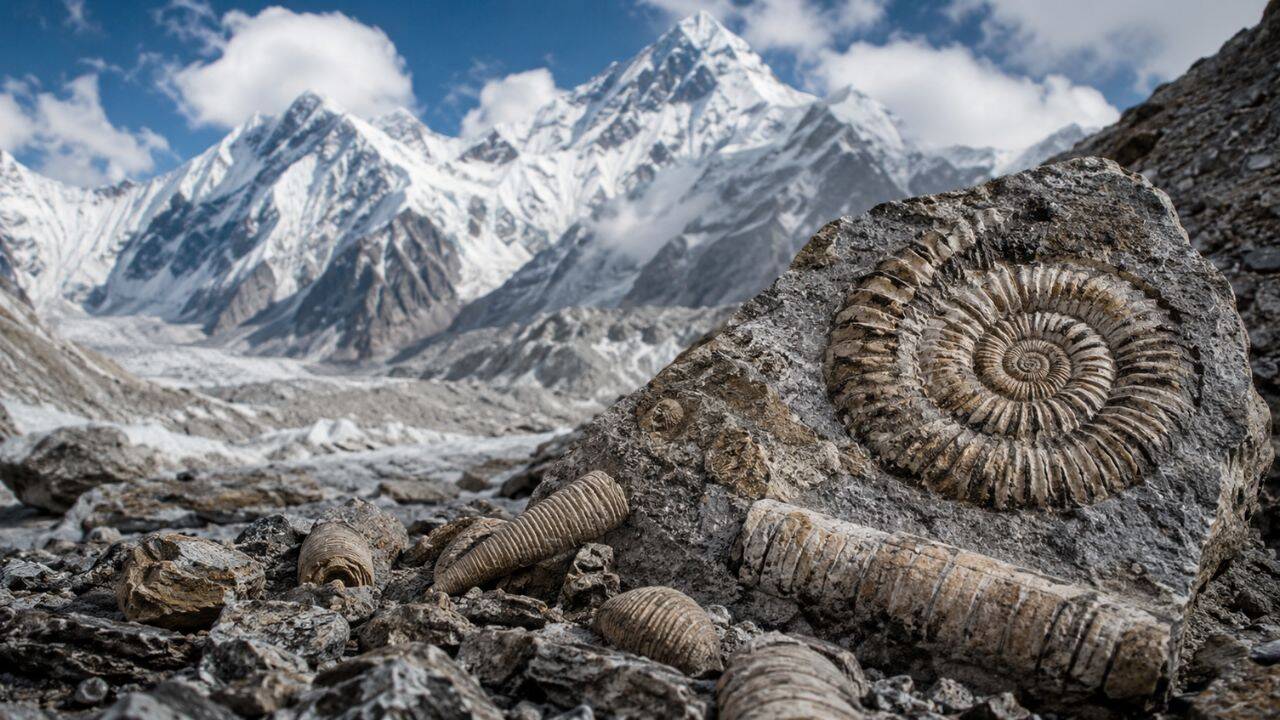
The riverbed of the Kali Gandaki River is famous for "saligrams." These are dark, fossilized ammonite shells preserved in smooth river stones. For centuries, they have been collected by travelers and locals alike. They are a direct result of the ancient Tethys Ocean floor being eroded and washed down from the high peaks.Visit Regional Stratigraphic Exhibits
Many natural history museums across the globe house rock thin-sections and geological samples from the Himalayan range. Look for exhibits focusing on plate tectonics, continental drift, or Ordovician marine life. Seeing the microscopic structure of Qomolangma Limestone under a microscope reveals the dense, fossilized skeletal fragments of ancient ostracods and crinoids that are invisible to the naked eye.👉 See also: camp david accords ofStudy Regional Geological Maps
You can access public stratigraphic databases from organizations like the Geological Society or regional survey departments. These maps trace the Qomolangma Formation as it dips and rises across the Himalayan chain, showing how the ancient sea floor was sheared and folded across thousands of miles of mountainous terrain.
The marine fossils on Mount Everest are a reminder that nothing on our planet is permanent. Oceans vanish, continents travel across the globe, and the bottom of the sea can become the highest point on Earth. It is a story written in stone, waiting for anyone willing to look closely at the rocks beneath their feet.
This video explains the incredible geological mechanisms and stratigraphic layers that pushed ancient ocean sediments to the top of Mount Everest.