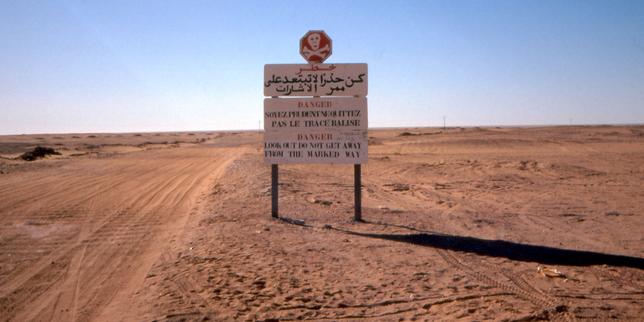
The Algerian government isn't playing around anymore when it comes to organized crime. Authorities are officially converting a remote military barracks deep inside the hyper-arid Tanezrouft desert into a high-security penitentiary built exclusively for major drug kingpins.
If you look at a map of North Africa, the Tanezrouft sits in the country's extreme southwest near the Malian border. Locals call it the "land of thirst" for a reason. It is one of the most blistering, unforgiving stretches of the Sahara, completely isolated from urban life. Putting a prison out there is a deliberate message. Kingpins won't just be locked away; they'll be completely cut off from the outside world.
The Breaking Point Behind the Tanezrouft Project
Why now? Drug trafficking has surged dramatically across Algeria. Recent statistics from the country's National Anti-Drug Office paint a grim picture, estimating that roughly three million people out of a population of 46 million struggle with addiction. That is a staggering social crisis.
Quantities are scaling up, too. Law enforcement agencies have faced massive maritime and overland smuggling operations, highlighted by record-breaking interceptions. Just weeks prior to the prison announcement, police seized a staggering ten million capsules of pregabalin alongside 33 kilograms of cocaine in a single sweep. When cartels start moving product on that scale, standard urban prisons lose their effectiveness. High-profile inmates often manage to keep running their syndicates behind bars using smuggled phones and corrupt channels.
The Tanezrouft facility aims to eliminate that risk entirely. Geography becomes the ultimate guard. Escaping a concrete cell is one thing. Surviving hundreds of kilometers of waterless Saharan wasteland on foot is entirely impossible.
Beyond the Walls: A New Anti-Drug Strategy
The desert fortress is only part of the equation. President Abdelmadjid Tebboune's High Security Council also greenlit the creation of a specialized security agency dedicated exclusively to narcotics. Styled after America's Drug Enforcement Administration (DEA), this new specialized branch will centralize federal intelligence and target transnational supply lines.
This aggressive policy shift coincides with intense regional and international pressure. Cross-border trafficking networks have increasingly linked North African smuggling routes with European syndicates, including high-profile arrests tied to European crime rings like Marseille's DZ Mafia. By tightening domestic security and establishing an impenetrable desert holding facility, Algiers is fundamentally rewriting how it handles organized crime.
Critics might point out the logistical nightmare of running a high-security complex in the middle of nowhere. Yet, that exact isolation is the entire point. When criminal networks grow powerful enough to threaten state stability, standard deterrents fail. Algeria is betting that extreme isolation is the only language the cartels will ultimately understand.