For decades, biology has operated like someone trying to understand a symphony by listening to a single violin. Researchers could zoom in on individual neurons or track the general rhythm of an entire organ, but watching how every single part of a living vertebrate talks to the rest of the body at the exact same millisecond? That felt impossible. Biology had a massive blind spot between the microscopic behavior of single cells and the macroscopic actions of a whole organism.
Everything just changed.
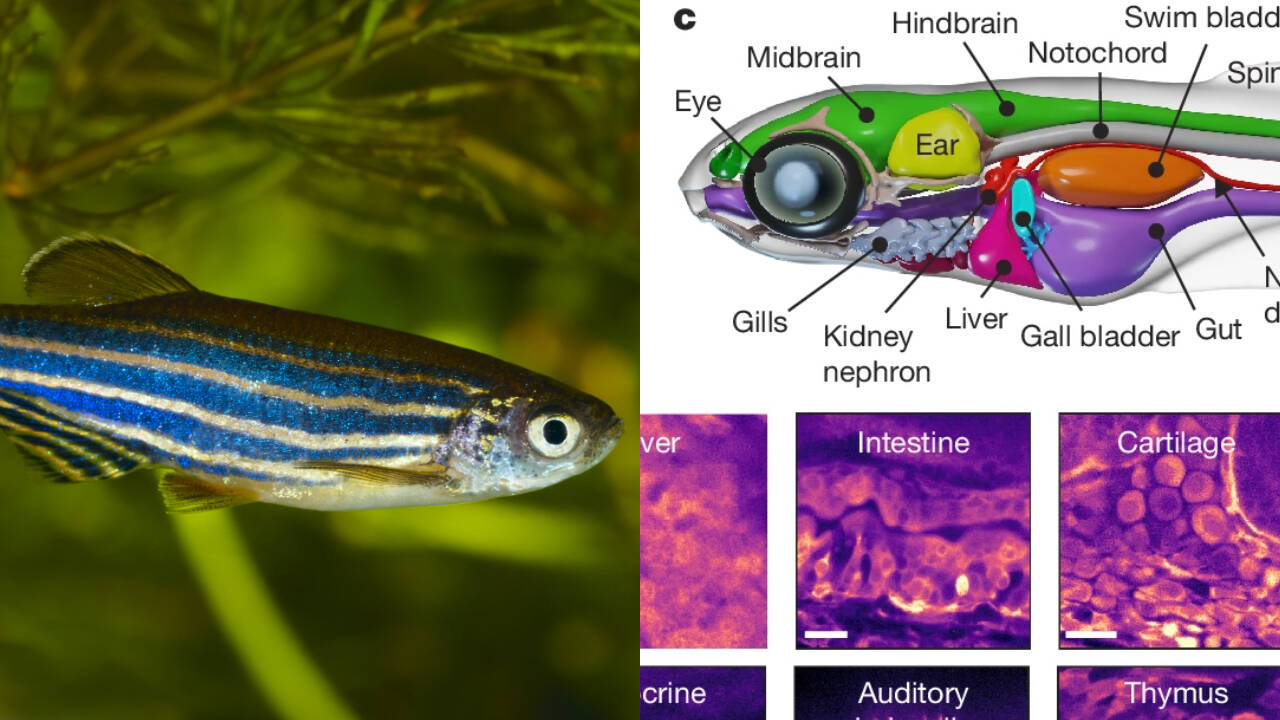
A team at HHMI's Janelia Research Campus has built a system that tracks cellular activity across nearly every cell in a living vertebrate simultaneously. Called WHOLISTIC—short for Whole Organism Live Imaging System for recording Tissue and IntraCellular activity—this technology finally bridges the gap between individual cellular firing and whole-body physiology. Published in the journal Nature, the breakthrough relies on transparent larval zebrafish to expose how signals travel across muscles, brains, hearts, and guts in real time.
The Calcium Secret That Makes It Visible
How do you watch thousands of cells light up at once? You use calcium.
Almost every cell in a vertebrate body relies on shifting calcium levels to transmit messages and coordinate tasks. Virginie Ruetten, a postdoctoral researcher in Misha Ahrens' Janelia lab, worked alongside international teams from University College London, Virginia Tech, and Tsinghua University to engineer a clever workaround. They introduced a specialized calcium sensor into cells throughout the entire fish.
When cells fire or react, the sensor lights up. Specialized microscopy captures the data, while custom computational tools align and process the massive influx of information. Researchers even use whole-body expansion microscopy afterward to inspect specific tissues at a higher resolution.
Previous setups stopped at the brain. The Ahrens lab and others mapped neural activity brilliantly, but the rest of the animal remained a black box. WHOLISTIC pulls back the curtain on the entire body.
What Happens When You Turn the Lights On
When you can finally see the whole organism at cellular resolution, surprising things start showing up.
Take oxygen deprivation, for instance. When researchers subjected the fish to low-oxygen environments, a coordinated body-wide defense kicked in immediately. The brainstem took charge, actively redirecting blood flow away from the digestive tract and straight toward the brain and muscles. Seeing this choreography play out live shows how multiple disparate systems negotiate survival under stress.
The system also exposed strange waves of activity creeping along the spinal cord and brain during long stretches of physical stillness. These signals originate in ependymal cells—the cells lining the fluid-filled spaces of the central nervous system. Scientists suspect these unexpected ripples might play a direct role in sleep or metabolic resting states.
Even pharmacology looks different under this lens. When researchers administered ketamine, they noticed it didn't just affect neurons. It activated surrounding connective tissue and other cells near the brain in ways standard assays completely missed.
Where the Research Goes Next
Larval zebrafish are convenient because they are see-through, but they are juveniles. The team is already adapting the technology for Danionella, a microscopic fish that stays transparent well into adulthood. That shift will let scientists monitor complex, mature behaviors without losing visual access to internal organs.
We are moving past the era of studying isolated organs in jars. Real biology happens in messy, interconnected networks. Now, we finally have the tool to watch them work.