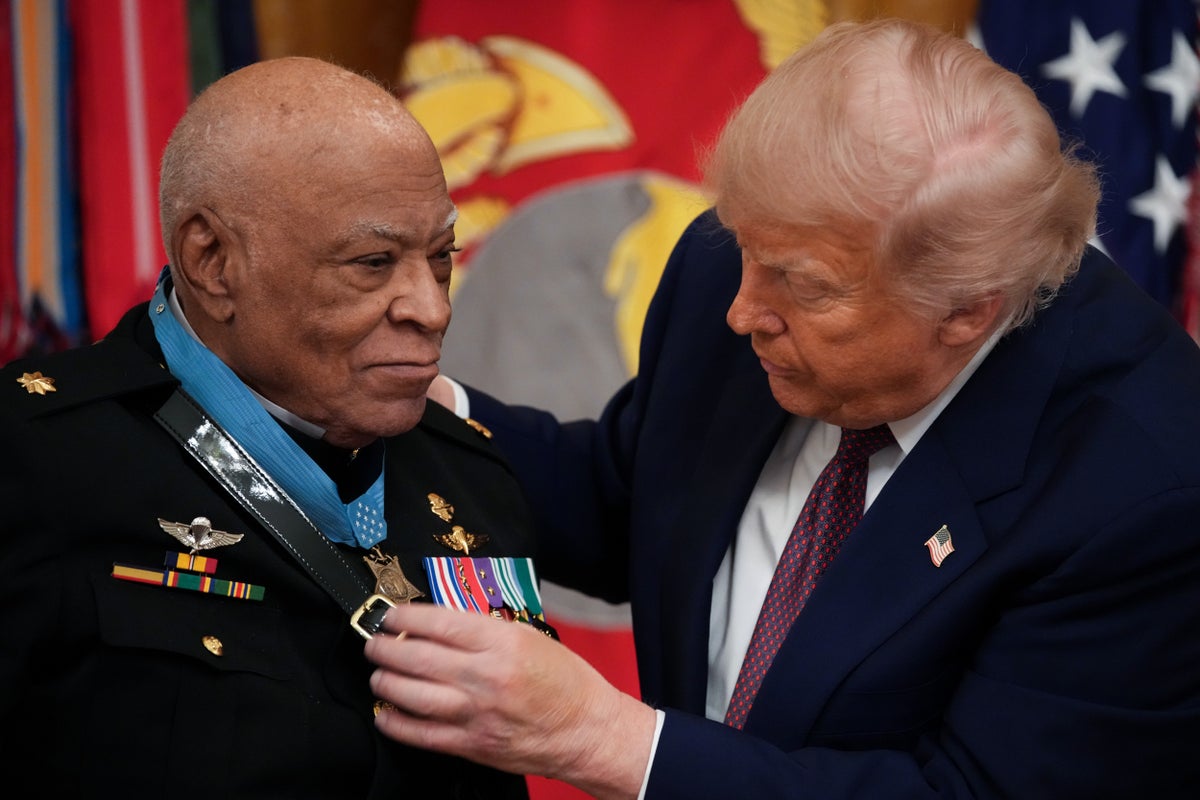
Standing in Arlington, Texas, Donald Trump looked at a room full of people who earned the nation's highest military decoration and said what he usually says out loud: he wished he could pin it on himself.
"I'd give it to myself. I have no problem."
Laughter followed. Then the pivot: I'm only kidding. Actually, I'm not kidding.
If you treat this like another Tuesday afternoon outrage cycle, you're missing the mechanics of how symbols, authority, and military culture actually collide in American politics. The Independent covered the basic line-item notes: the Arlington visit, the bone spur backstory from Queens in the sixties, the Nobel comparison, the Woody Williams monument signing. Fine reporting. Standard wire copy.
It completely misses why this particular fantasy reveals a fundamental misunderstanding of what the Medal of Honor represents.
The Architecture Of Valor And Why You Can't Self-Sully It
The Congressional Medal of Honor isn't a trophy for being boss of the building. It requires specific, codified criteria under Title 10 of the United States Code: gallantry and intrepidity at the risk of life, above and beyond the call of duty, in action involving conflict with an opposing foreign force.
Notice the physics of that requirement. Action. Risk. Extrema where survival probability approaches zero and choice collapses into sacrifice for peers.
When a commander-in-chief suggests self-award—even as a half-wink joke delivered to actual recipients—they collide with a hard psychological barrier in the ranks. Service members care less about the metal ribbon and more about the chain of custody of honor. If the apex of the civilian hierarchy treats military decoration like an executive bonus plan or a vanity plaque, the currency devalues.
Ask any retired sergeant major or master chief petty officer what happens when standards look negotiable. Morale doesn't dip; cynicism hardens.
The Presidential Decorator Complex
Presidents love handing out metal. Eisenhower wore his five stars with earned weight. JFK understood World War II sacrifice intimately. Lyndon Johnson draped ribbons with a heavy-handed political gravity.
Trump operates in a different psychological register. To him, status is flat, infinite, and transactional. If the Nobel Committee slights him—complaining Norway finds him conservative—handing yourself a domestic substitute or complaining about statutory barriers looks less like tyranny and more like a grievance broadcast from a reality TV boardroom.
Look at the contrast from that same week: signing authorization for the Hershel "Woody" Williams National Memorial on the National Mall. Woody Williams burned through flame-thrower ammo on Peleliu in 1944. Woody spent decades visiting Gold Star families. Woody never joked about pinning a star to his own collar.
That gap—between the quiet weight of Woody Williams and the live-mic stream of consciousness in Arlington—is where the real story lives.
What Washington Gets Wrong About Military Symbols
Civilians think military medals are resume builders stamped by the state. Veterans know they are ghost stories paid for by friends who didn't come home.
When politicians treat valor as personal branding property, two things happen:
- The public tunes out legitimate institutional critique because everything sounds like partisan noise.
- The culture of the military drifts further from civilian comprehension, treated by Washington either as a prop station or an HR department.
Trump isn't the first politician to dream of supreme validation. Julius Caesar wanted crowns; monarchs collected chest-fulls of foreign brass they never smelled gunpowder near. American constitutional design specifically tried to break that loop. No titles of nobility. No self-awarded martial supremacy. Civilian control of the military works precisely because the civilian wears a business suit and stays outside the ring of blood-bought recognition.
Where This Goes From Here
Stop taking the bait as a constitutional crisis or writing it off as harmless joker energy. It is neither.
It is a window into a transactional worldview that treats institutional honor as locked behind a bureaucratic door rather than anchored in physical reality. When someone tells you they'd award themselves the nation's highest combat decoration, believe the second sentence: Actually, I'm not kidding.
Recognize the symbol for what it is. Guard the threshold of military sacrifice from the gravitational pull of reality-show self-mythology. Watch the actions, read the statutory walls, and leave the fantasy medals in the gift shop where they belong.

:max_bytes(150000):strip_icc()/rafaelamayaletraporletra2008-6a7119cc47434e05bd6b27adf9740873.jpg)