A moderate tremor shouldn't cause a tragedy. When a 5.5 magnitude earthquake struck the rugged Andes region of Peru on a chilly Saturday night, it wasn't a tectonic monster. In the grand scheme of global seismology, a 5.5 rating is modest. Yet, this single event killed at least six people, left more than thirty injured, and turned three hundred villagers into refugees overnight.
The ground shook, but the buildings did the killing.
If you look at the raw data from the US Geological Survey, the quake hit at 9:24 p.m. local time, centered just two kilometers west-southwest of Sicaya in the Huancayo province. It happened at a shallow depth of ten kilometers. Shallow quakes pack a nasty, violent punch because the energy doesn't have time to dissipate before reaching the surface. Even so, modern engineering handles this level of shaking easily. The real crisis in Peru's central highlands isn't the moving fault lines. It is the fragile mud brick holding up the roofs.
The devastation across towns like Pumpuya and Chongos Bajo exposes a glaring truth. We keep blaming nature for disasters that are entirely manufactured by poverty, lack of regulation, and unsafe building traditions.
The Deadly Trap of Unreinforced Mud
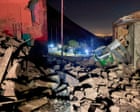
Walk through the agricultural valley of Chongos Bajo today and the scent of pulverized earth fills the air. Families are huddled under heavy blankets in the freezing high-altitude air, staring at piles of dirt that used to be their living rooms. The culprit behind this mass destruction is adobe.
Adobe is basically sun-dried mud brick mixed with straw. People in the Andes have used it for centuries. It makes total sense on paper. Adobe is incredibly cheap, it requires zero specialized manufacturing, and it provides brilliant thermal insulation against the brutal Andean nights. When the temperature drops outside, an adobe house stays remarkably warm.
But adobe has a fatal flaw. It handles compressive weight well but possesses almost zero tensile strength. When the ground moves sideways during an earthquake, unreinforced adobe walls simply shear, crumble, and collapse outward or inward. They don't just crack. They disintegrate into heavy, suffocating debris.
Luis Vásquez, who heads the local civil defense office, put it bluntly to reporters following the tragedy. He noted that the heavy reliance on rustic adobe materials across this entire Andean zone directly caused the high rate of structural failure and casualties. When these roofs fall, they carry heavy clay tiles and massive wooden beams with them. Residents inside have seconds to move. Many don't make it.
When History Turns to Dust
The loss isn't only counted in human lives and shattered homes. This earthquake tore a hole directly through Peru's cultural heritage.
In Chongos Bajo, the historic Santiago de León church and its adjacent convent suffered catastrophic structural failure. Built way back in 1565, this complex stood for nearly five centuries. It was officially designated as a national heritage site, celebrated as a rare 16th-century architectural jewel. Now, parts of it look like a bombed-out war zone.
Preserving ancient structures in highly active seismic areas presents an agonizing challenge. These colonial-era churches were built with massive, thick adobe and stone walls. They rely on sheer mass to stay upright. Over centuries, repeated micro-tremors weaken the internal mortar. Then, a sharp, shallow 5.5 magnitude shock arrives at the right frequency, and the whole system fails.
It breaks your heart to see centuries of history reduced to rubble in less than twenty seconds. But it also highlights a massive blind spot in heritage management. We tend to treat historic buildings as static museum pieces instead of dynamic engineering challenges that require active seismic retrofitting.
The Human Faces in the Rubble
Statistics can make you numb. It is easy to read "six dead" or "three hundred displaced" and flip to the next page. The real reality is found in the voices of those who ran for their lives into the darkness.
Take Hermenegilda Guamalato. She spoke to a local radio station while frantically trying to secure emergency shelter for her three young children. Her home in the agricultural heartland was completely flattened. She was forced to flee to the neighboring district of Huayucachi just to find a safe place for her kids to sleep.
Imagine sitting in your home at 9:30 on a Saturday night. The lights flicker out. The earth roars. The very walls meant to protect you begin raining chunks of heavy dirt onto your head. You grab your children, stumble through the dark, and step out into an environment where your entire neighborhood has collapsed into the street.
Emergency teams from Peru's National Civil Defense Institute are working around the clock, but their job is incredibly difficult. The total number of missing people remains uncertain. In these remote mountain villages, tracking down every single resident takes time. Communication lines are down, roads are blocked by minor rockslides, and local resources are stretched to the absolute limit. Even domestic animals remain trapped beneath the fallen brickwork, adding another layer of economic ruin for these farming households.
Living on the Edge of the Ring of Fire
Peru sits squarely on the Pacific Ring of Fire, one of the most volatile tectonic zones on earth. The oceanic Nazca Plate is continuously shoving itself underneath the continental South American Plate at a rate of several centimeters per year. This process creates the gorgeous, towering peaks of the Andes. It also creates a ticking time bomb.
The region knows immense tectonic violence. Older residents still vividly remember the horrific 2007 earthquake that struck the coastal province of Pisco in the Ica region. That was a massive 7.9 magnitude monster. It wiped out entire towns and killed nearly six hundred people.
Because of events like Pisco, Peruvians understand the danger of big coastal subduction quakes. Coastal cities like Lima have updated their building codes and regularly run mass earthquake drills. But the rural Andean highlands are completely different stories. Out here, far from the capital, enforcement of building codes is practically non-existent. People build with what they can find, what they can afford, and what they know.
That lack of oversight turns a moderate inland tremor into a localized disaster. A 5.5 magnitude earthquake happens somewhere in the world almost every single day. In California, Japan, or Chile, it rarely causes more than a few rattled nerves and some fallen books. In rural Peru, it brings down churches and crushes families.
What We Need to Do Right Now
We have to stop pretending this is just an unpredictable act of God. The solutions to adobe housing vulnerability exist. They are cheap, they work, and they can be implemented using local materials.
Engineers in Peru have spent years testing ways to make adobe homes safe. The most successful method involves reinforcing mud walls with high-tech plastic geomesh or even basic, locally sourced materials like cane and nylon mesh. By wrapping the adobe walls in this netting and plastering over it, you create a cohesive system. When the earthquake hits, the walls might crack, but they won't fall apart. The house stays standing long enough for everyone to run outside safely.
Saving lives in the next earthquake requires taking three immediate, concrete steps.
First, regional governments must fund mass seismic retrofitting programs specifically for rural homeowners. Handing out plastic tarps and blankets after a disaster is a band-aid on a bullet wound. We need to proactively reinforce existing adobe structures before the ground shakes.
Second, local municipalities must train rural builders in basic seismic-resistant adobe construction techniques. People are going to keep building with mud because they cannot afford concrete and steel. We have to make mud construction safe.
Third, engineering teams must immediately assess and seismically brace historic colonial structures using internal tie-rods and reversible structural reinforcement. We cannot keep losing our history to moderate tremors.
If you want to support the immediate relief efforts on the ground, consider donating directly to verified humanitarian organizations operating in the Junín region, such as the Peruvian Red Cross or local community-led funds providing hot food, clean water, and warm blankets to displaced families in Huancayo. Stop waiting for the big one to act. The medium ones are already doing enough damage.