Pop culture loves to paint Tyrannosaurus rex as an unstoppable monster that casually snapped its prey in half. Movie screens show them charging blindly, teeth flashing, instantly obliterating everything in their path. The real world was far messier, far more violent, and infinitely more fascinating. A spectacular fossil study published in the journal PeerJ shows exactly how calculated these ancient battles were, giving us an unprecedented look at the true T. rex attack style.
Forget the cinematic chase scenes. The reality of Late Cretaceous predation was a brutal game of leverage, raw power, and close-quarters combat. Paleontologists analyzing an ancient duck-billed dinosaur skull found something extraordinary: a broken tyrannosaur tooth lodged deep inside the animal's face. It is a literal smoking gun from 66 million years ago. This single piece of bone tells a story of a terrifying head-on clash that shatters many long-held assumptions about how the king of dinosaurs actually brought down its meals.
The Hell Creek Crime Scene
The story begins in 2005 in eastern Montana. Field crews working the fossil-rich layers of the Hell Creek Formation unearthed a nearly complete skull of a duck-billed herbivore known as Edmontosaurus. Designated as specimen MOR 1627, the skull was beautiful, highly detailed, and immediately put on display at Montana State University’s Museum of the Rockies. For years, museum visitors walked past it, admiring its shovel-like beak without realizing they were staring at the remnants of a prehistoric murder mystery.
Fast forward to 2026.
Taia Wyenberg-Henzler, a doctoral researcher from the University of Alberta, teamed up with John Scannella, the curator of paleontology at the Museum of the Rockies. They decided to take a much closer look at MOR 1627. What they discovered changed our understanding of tyrannosaur behavior. Scattered across the duckbill's skull were 23 distinct tyrannosaur bite marks. Even more shocking, a partial tooth crown was completely embedded right in the nasal bone of the face.
Finding bite marks on fossilized dinosaur bones happens fairly often. Predators chewed on carcasses, chewed on bones, and left plenty of scratches behind. Finding an actual tooth broken off and stuck inside the bone of a prey animal is incredibly rare. It provides definitive proof of identity. You do not just know someone got chewed on; you know exactly who did the biting.
Identifying the Attacker Without a Doubt
You might wonder how scientists can be so sure the tooth belonged to a T. rex. The Hell Creek ecosystem was home to other meat-eating dinosaurs, after all. Small raptors darted through the brush, and for years, scientists have argued over the existence of Nanotyrannus, a smaller, more slender cousin of the king.
Wyenberg-Henzler and Scannella did not guess. They ran the forensic data.
The researchers compared the embedded tooth fragment against every single carnivorous species known from that specific geological layer. They looked at the size. They measured the curvature. They examined the microscopic denticles, which are the tiny, knife-like serrations running down the edge of the tooth.
The results were clear. The tooth possessed an ovoid cross-sectional shape and specific serration patterns that perfectly matched an adult Tyrannosaurus rex maxillary tooth. This was not a juvenile T. rex testing its strength, nor was it a smaller predator trying its luck. This was a fully grown, multi-ton apex predator using its upper jaw to deliver an apocalyptic amount of force.
The Physics of a Face Bite
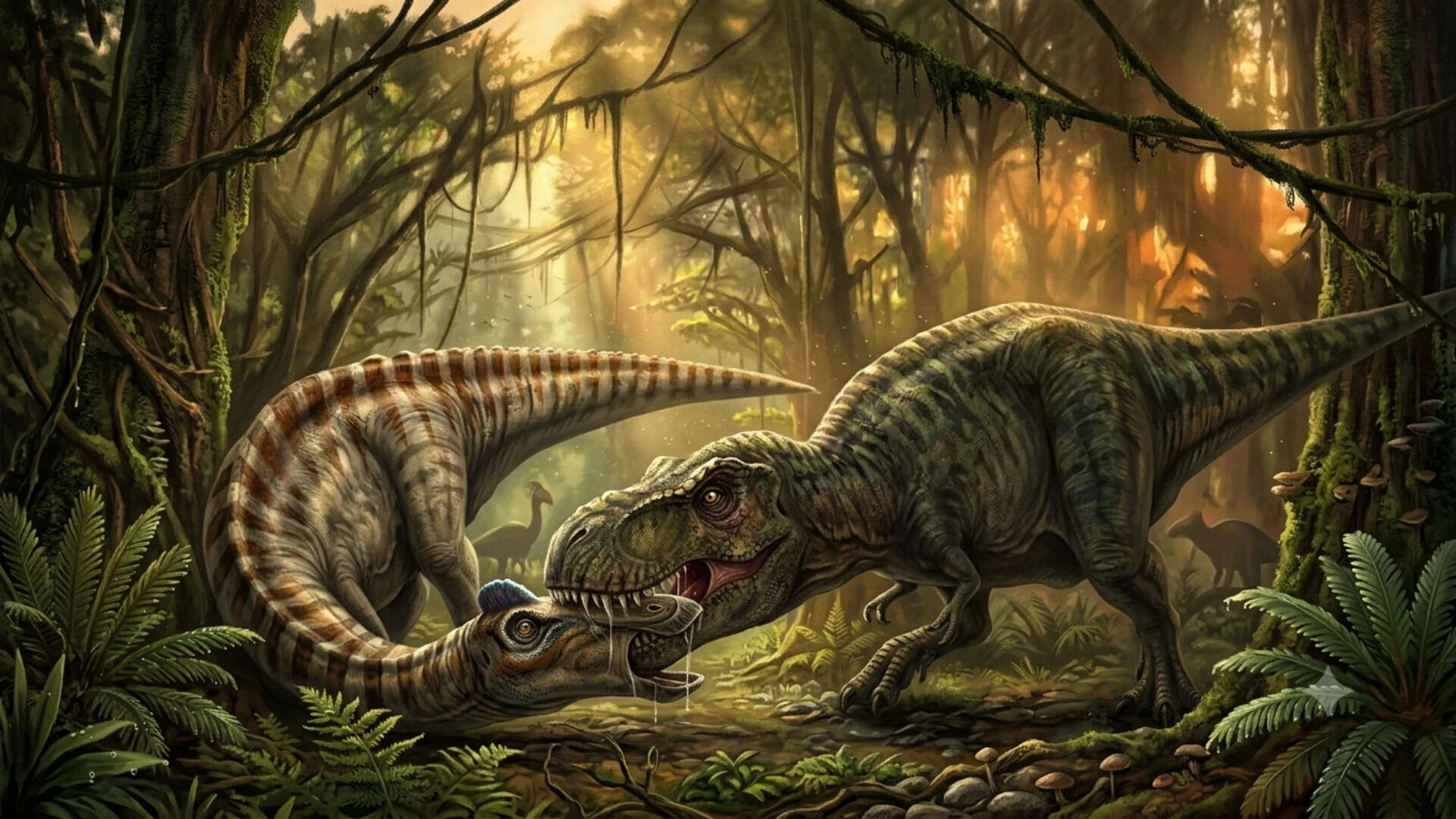
The location of the tooth changes everything we thought we knew about the T. rex attack style. The fragment is lodged directly in the snout of the Edmontosaurus, penetrating straight into the nasal cavity.
Think about that for a second.
Previous fossil discoveries suggested that T. rex preferred to sneak up from behind. Paleontologists have found healed tyrannosaur bite marks on Edmontosaurus tail bones before, indicating that the predators would ambush herds from the rear, biting at the tail to slow the animal down. It makes sense. It is exactly how great white sharks surprise seals.
This fossil tells a completely different story. The placement proves the two multi-ton animals were standing face-to-face when the impact happened.
[ T. rex ]  -->  Face-to-Face Impact  <--  [ Edmontosaurus ]
                      (Snout Bite)
Biting a massive, struggling herbivore directly in the face takes an incredible amount of violent commitment. The Edmontosaurus was not running away; it was actively confronting or being frontally subdued by its attacker. To snap a thick, solid T. rex tooth inside living bone requires massive lateral stress. The duckbill was likely thrashing wildly, fighting for its life, causing the predator’s tooth to twist and shear off completely under the immense pressure of the struggle.
Advanced CT scans performed at Bozeman Health Deaconess Hospital revealed the internal damage. The tooth sliced through the bone with terrifying ease. There are absolutely no signs of healing or bone remodeling around the wound.
In paleontology, a healed wound means the animal escaped and lived to tell the tale. A completely unhealed wound means one of two things: either the Edmontosaurus died right then and there because of the attack, or the T. rex was biting into an animal that was already dead.
Predator or Scavenger
For decades, a fierce debate divided the paleontology community. One camp insisted T. rex was an active hunter, a hyper-aggressive killer that chased down prey. The other camp argued it was merely a giant, slow scavenger, a glorified corporate vulture of the Cretaceous that used its massive size to bully smaller predators away from rotting carcasses.
Modern consensus has settled on a middle ground: T. rex was an opportunistic carnivore. It would gladly hunt when it needed to, and it would happily eat a dead corpse if it stumbled across one. It did not care about sportsmanship; it cared about calories.
MOR 1627 provides incredible context for this exact dynamic. The face bite strongly indicates active predation. When modern mammalian or reptilian carnivores hunt, they frequently go for the head or the throat to control the prey, stop it from escaping, or deliver a quick, crushing blow. Scavengers do not usually engage in high-stakes face-biting contests with a corpse; they go straight for the soft tissues of the belly, rump, or limbs where the highest concentration of meat is found.
However, the other 23 bite marks on the skull show what happened after the initial strike.
The scientists noticed that these additional bite marks were strategically clustered. On the right side, they sat right behind the eye socket. On the left side, they lined the back third of the lower jaw. In duck-billed dinosaurs, these specific zones housed the massive jaw muscles used for grinding tough plants. A dinosaur's face is mostly skin and bone, but the back of the skull held serious meat.
The T. rex did not just kill the Edmontosaurus; it systematically processed the carcass. Once the prey was down, the king used its banana-sized teeth like a precision tool, stripping the heavy chewing muscles off the skull to ensure no protein went to waste.
Spotting the Details on Your Next Museum Trip
The next time you visit a museum or look at a dinosaur skeleton, do not just look at the overall size. Look closer. The real science lives in the imperfections.
If you want to understand prehistoric life like an expert, look for these details on fossilized bones:
- Puncture pull marks: Look for deep, V-shaped grooves in the bone. T. rex did not bite cleanly like a mammal; it drove its teeth deep into the target and then pulled straight back, dragging its serrated teeth through bone and muscle alike.
- Woven bone texture: If you see a rough, spongy texture around a bone scar, that is reactive bone growth. It means the dinosaur survived the attack and lived for weeks, months, or years afterward while its body repaired the structural damage.
- Smooth, unhealed edges: Clean punctures with sharp, crisp edges mean the bite happened at or very near the time of death. There was no blood flow or immune response left to fix the damage.
The Museum of the Rockies skull is an incredible testament to the brutal reality of the Cretaceous period. It reminds us that these animals were not mythical monsters acting out scripted movie scenes. They were real, living creatures that engaged in messy, desperate struggles for survival every single day. The next time someone tries to tell you T. rex was just a slow scavenger or a clumsy giant, tell them to look at the face of MOR 1627. The broken tooth buried in that snout tells you everything you need to know about what happened when you met the king face-to-face.