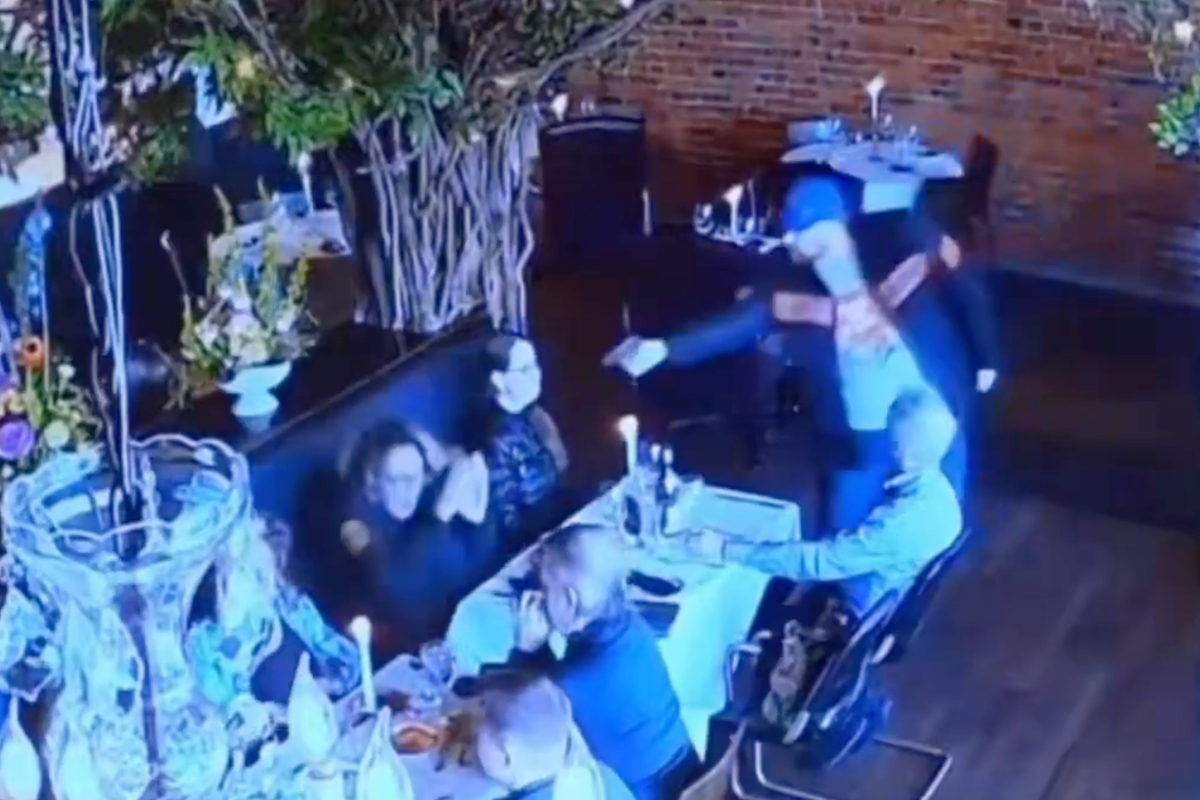
You never really expect violence to interrupt a dinner service. Most people go out to eat for comfort, food, or a quiet break from everyday noise. But for the staff and diners at Sabira, an Italian restaurant in downtown Toledo, Ohio, a quiet night turned instantly chaotic when a former attorney walked in with a loaded handgun and a terrifying agenda.
Matthew Exton, a 43-year-old former lawyer, tried to commit a public shooting on April 11, 2025. He targeted his ex-wife during the restaurant's opening night celebrations. What stopped a tragedy wasn't just police response times or elaborate high-tech security systems. It was a combination of a mechanical oversight—the gun's safety was left on—and sheer, split-second physical intervention by a brave waiter and nearby patrons.
Exton was later convicted of attempted murder, two counts of felonious assault, and multiple firearm specifications by a Lucas County jury. Facing up to 25 years in prison, his case brings up uncomfortable questions about domestic violence spilling into public spaces, situational awareness, and how little standard hospitality training prepares workers for extreme threats.
How the Attack Unfolded at Sabira
The sequence of events reads like a worst-case scenario. Exton had reportedly been drinking at a nearby bar before spotting his ex-wife and her family dining at Sabira. He initially walked inside, sent a drink over to their table, and spat toward them as he left. That hostile gesture should have raised immediate alarms, but public spaces are rarely structured like fortresses.
He left, armed himself, and returned with a handgun. Surveillance footage captures him walking straight toward his ex-wife's table with lethal intent. When he raised the weapon and pulled the trigger at point-blank range, nothing happened. The safety switch was still engaged.
That microsecond delay bought just enough time for a restaurant waiter and courageous diners to react. Instead of freezing, they charged the armed man, tackling him to the ground and wrestling the weapon away before he could fix the safety or fire another shot. Lucas County Prosecutor Julia Bates later noted that restaurant soft openings don't train staff to handle active attackers, yet these workers stepped up anyway.
The Reality of Public Violence and Domestic Disputes
Domestic violence rarely stays neatly confined behind closed doors. When perpetrators cross the line into public venues, businesses become accidental frontline defenders. Exton's trial revealed a toxic mix of obsession and rage. During his defense, Exton bizarrely claimed he didn't intend to pull the trigger and was merely trying to pressure his ex-wife into speeding up the sale of their former home.
The jury didn't buy that absurd excuse. Prosecutors pointed out that the weapon was loaded with a round in the chamber and seven more in the magazine. This wasn't an accidental confrontation or a misunderstood conversation. It was an attempted execution that failed due to mechanical error and human bravery. Exton’s disruptive courtroom behavior—which led to him being removed during closing arguments—further underscored a total lack of remorse or rational control.
What Businesses and Patrons Must Learn
We talk a lot about security protocols in schools, airports, and corporate offices. We rarely discuss them for local restaurants, cafes, and neighborhood bars. When you sit down for a meal, your guard is down. That makes spaces like Sabira soft targets for unstable individuals.
Owners and managers face a brutal reality check. While you can't turn every dining room into a high-security zone, you can foster a culture of observation. Staff members notice behavioral shifts in patrons faster than anyone else. Spotting aggression early—like the initial hostility Exton showed when he spat at the table—is the only real early warning system a restaurant has.
We also have to reckon with the legal and professional fallout. Exton had his law license suspended by the Ohio Supreme Court shortly after the attack. A career built on upholding the law ended in an attempted murder conviction.
Violence of this magnitude leaves invisible scars on everyone involved. The waiters, the chefs, and the diners who tackled an armed man didn't sign up to be heroes. They just wanted to finish their shift or enjoy their meal.
Take a closer look at your surroundings the next time you step into a crowded public venue. Notice the exits. Pay attention to sudden shifts in the room's energy. Most importantly, recognize that safety isn't guaranteed by luck alone—sometimes, it takes ordinary people refusing to look away when danger walks through the door.