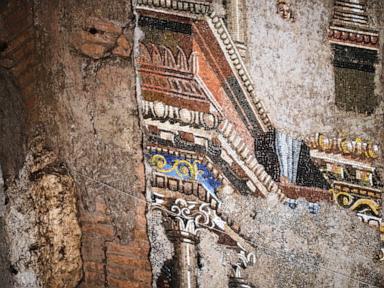
You won't find this ancient roman fresco on most standard tourist itineraries just yet. Rome just pulled back the curtain on what experts believe is the largest wall fresco and mosaic complex from antiquity. Hidden beneath the Oppio hill near the Colosseum, these subterranean marvels survived decades of obscurity after workers first stumbled upon them in the 1990s. Now, city officials have finally cleaned, stabilized, and opened these fragile spaces to the public.
If you've ever wondered how ancient Romans visualized their coastal settlements, you are in luck. The "Painted City" fresco and the sprawling "Great Mosaic" offer a direct look into a first-century C.E. coastal metropolis. Let’s look at why these discoveries matter and what you need to know if you plan to visit.
What is the "Painted City" Fresco?
The standout piece is a roughly 107-square-foot wall painting depicting a walled port city from a bird's-eye perspective. Rendered in fading yet distinct blues and terra cotta hues, the artwork shows an intricate layout featuring public piazzas, towers, a theater, and a temple.
Rome’s cultural superintendent, Claudio Parisi Presicce, notes that nobody knows exactly which city the artist painted. It likely represents a real, highly famous coastal hub of the era rather than a fictional place. What makes the piece truly remarkable is its perspective. Long before Renaissance masters mastered geometry, this first-century painter captured architectural depth and spatial awareness with striking clarity.
The Scale of the Great Mosaic
Beneath or alongside the painted walls sits an even more massive artifact: the Great Mosaic. Standing roughly 33 feet high and stretching 52 feet wide, archaeologists think it's the largest wall mosaic ever uncovered in the Roman world.
The structure of the mosaic spans multiple distinct tiers:
- The upper sections display detailed theatrical scenes featuring human figures, poets receiving laurel crowns, and bearded philosophers.
- The lower levels showcase detailed bird's-eye layouts of a port city, matching the thematic coastal focus of the nearby fresco.
- Ongoing excavations continue to reveal new sections, including artwork depicting grape harvesting and traditional winemaking.
How the Baths of Trajan Connect to the Find
These artworks didn't just appear out of nowhere. They were discovered in underground galleries that served as foundations for the massive Baths of Trajan. Dedicated by Emperor Trajan in 109 C.E., the baths covered roughly 15 acres. They stood as the largest thermal complex in the world at that time.
Architect Apollodorus of Damascus designed the baths to sit atop older structures, including parts of Emperor Nero’s infamous Domus Aurea palace. Because the fresco and mosaic sit deep beneath the bath foundations, experts believe they actually predate Trajan's construction by decades. They might even have belonged to Nero's lavish palace complex, though absolute proof remains elusive.
Visiting the Underground Galleries
Don't expect to just walk right in off the street. Because centuries underground made these surfaces extremely sensitive to humidity and climate shifts, authorities are taking a cautious approach.
Rome's mayor, Roberto Gualtieri, launched a strict trial period. Access is currently limited to small groups of no more than 15 people during weekend slots. Officials want to monitor how body heat and environmental changes affect the ancient pigments before opening the site up to broader tour groups.
If you want to secure a spot for the weekend visits, you'll need to watch local municipal cultural announcements closely and book a reservation well in advance. Above ground, you can also explore the semicircular exedra wall—believed to have functioned as an ancient library where Romans stored scrolls and held intellectual debates.
Plan your travel ahead, keep an eye on official reservation slots for the Oppio hill underground galleries, and experience one of Rome's best-kept archaeological secrets before the crowds catch on.
Ancient Roman thermal baths exploration
This video provides an on-site look at the Trajan thermal baths and the context of the newly opened underground complex in Rome.
http://googleusercontent.com/youtube_content/1