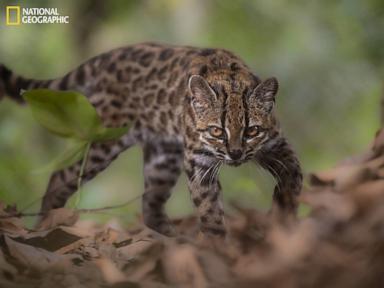
A local resident in Bolivia found a tiny stray animal on the road, assumed it was a standard housecat, and fed it a steady diet of noodles, rice, and eggs. It wasn't a domestic pet at all. That confused rescue marked the beginning of a scientific breakthrough: the formal identification of Leopardus tilcayo, the first new living feline species described and named in over a century.
Published in the journal Current Biology, this discovery shatters long-held assumptions about South America's small spotted cats. If you thought modern science had already cataloged every furry creature roaming the planet, think again.
Meet the Tilcayo Cat
Measuring roughly 46 centimeters long and tipping the scales at just 1.4 kilograms (about 3 pounds), the tilcayo is actually smaller than your average house cat. It sports light-brown fur, rounded ears, and striking, irregularly shaped rosettes across its body.
The animal hails from the Yungas, a rugged, mountainous cloud-forest region in Bolivia where the towering Andes slam straight into the Amazon basin. Local communities have known about this creature for generations, passing down the name "tilcayo" through family lines. While scientists had no formal record of it, indigenous wisdom kept the identity alive long before any DNA sequencer entered the picture.
How a Sanctuary Visit Sparked a Decade-Long Mystery
The journey to validation started back in 2016. Paola Nogales-Ascarrunz, a National Geographic Explorer and biologist, received a call from the Senda Verde Wildlife Sanctuary near La Paz about an unusual, tiny wild cat brought in by a local citizen.
When Nogales-Ascarrunz arrived, she took dozens of photos, initially suspecting the animal belonged to a known species of tiger cat (Leopardus tigrinus). But a few years later, while reviewing her reference images, a glaring mismatch caught her eye. The rosettes and physical layout didn't line up with tiger cats found in neighboring regions.
She teamed up with geneticists, including Jonas Lescroart of the University of Antwerp and Eduardo Eizirik, to extract and sequence complete genomes from 38 cats across the Leopardus genus.
The genomic data didn't just tweak current classifications—it blew them wide open.
Redrawing the Cat Family Tree
DNA analysis revealed that tiger cats are not just one or two groups, but a complex comprising five distinct species. More importantly, the tilcayo lineage split from its closest relatives roughly 1.4 million years ago. That evolutionary gap is massive, roughly comparable to the historical divergence between modern lions and extinct cave lions.
This marks the first entirely new living cat species formally described since the pampas cat gained recognition back in 1923.
The Urgent Conservation Crisis Behind the Cute Face
Finding a brand-new cat sounds like pure triumph, but conservationists are sounding alarms. When multiple distinct species get lumped together under a single umbrella classification, population numbers look deceptively healthy.
Right now, scientists have limited data on Leopardus tilcayo. Knowledge stems from a tiny handful of camera-trap logs and two live individuals studied up close, including a 10-year-old male currently living out his days at the Senda Verde sanctuary. Scat samples recovered from the wild suggest they hunt small rodents, and camera traps show they lean heavily nocturnal.
The International Union for Conservation of Nature (IUCN) will now have to reassess these feline lineages independently. Protection policies built for a generalized "tiger cat" category will no longer cut it. If you want to protect biodiversity in the Yungas cloud forests, you have to acknowledge the distinct species hiding in plain sight. Stop assuming our maps of nature are complete, and start funding the genetic field research required to protect what is actually out there.