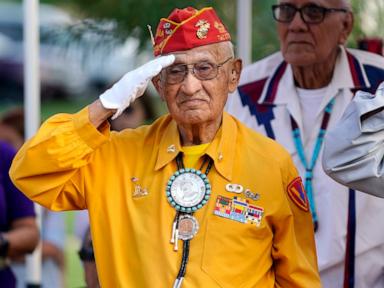
History often hides its most vital saviors in plain sight. On National Code Talker Day, crowds gather in Phoenix to honor a legacy built on linguistic brilliance and absolute sacrifice. Thomas H. Begay, now 101 years old, stands among the final two surviving Navajo Code Talkers. Think about that number. One hundred and one.
The Language That Saved Allied Forces
During World War II, the United States Marine Corps recruited hundreds of Navajo men to build an unbreakable tactical code. Military leaders needed a communication system that Japanese intelligence couldn't intercept or decode. They found it in the unwritten Navajo language.
It wasn't just about translation. The soldiers developed a complex dictionary of substitute words, turning everyday terms into military designations. An owl meant a fighter plane. A dive bomber became a chicken hawk.
Between 1942 and 1945, these code talkers transmitted thousands of critical messages about battle tactics and enemy movements across the Pacific. They did it under extreme pressure. Their accuracy was staggering. They basically handed the Allies a secure lifeline when other encryption methods kept failing.
A History Born From Contradiction
You can't talk about the Code Talkers without facing the deep irony of their service. Many of these men, including Begay, were forced into government boarding schools as children. There, authorities punished them heavily for speaking their native tongue.
Years later, the federal government turned right back around and asked them to use that exact language to protect the nation.
Laura Tohe, the Arizona poet laureate and daughter of a code talker, points out how massive that contradiction is. Yet, despite a dark and complicated history with the U.S. government, these men stepped up. They felt a profound responsibility to serve. They answered the call anyway.
The Decades of Silence
When the war ended, the mission didn't earn an immediate ticker-tape parade. It earned a stamp of strict classification.
The military swore the code talkers to absolute secrecy. For decades, these veterans couldn't tell their wives, children, or neighbors what they did during the war. They carried the weight of saved battalions in complete silence.
The program remained a military secret until 1968. Recognition arrived slowly after that. President Ronald Reagan finally established August 14 as the official day to honor the Navajo Code Talkers and all Native American service members in 1982.
Keeping the Legacy Alive Now
Today, the physical reminders of this generation are fading fast. Aside from Thomas Begay, Peter MacDonald stands as the other living link to this history. MacDonald enlisted at just fifteen years old by bending the truth about his age, later working as an engineer and navigating tribal politics.
Advocates fight daily to keep these stories from slipping through the cracks. Recent political shifts and administrative errors have occasionally threatened federal recognition pages honoring Native American veterans, drawing sharp condemnation from tribes and forcing swift web restorations. Meanwhile, efforts to build a dedicated museum on the Navajo Nation faced hurdles, though fresh plans recently surfaced to establish a permanent tribute in Farmington, New Mexico.
When you look at Thomas Begay saluting in Phoenix, you aren't just looking at an aging veteran. You're looking at a living anchor of American history. Listen to their stories while we still have the chance.