Setting half a billion dollars on fire makes for great television.
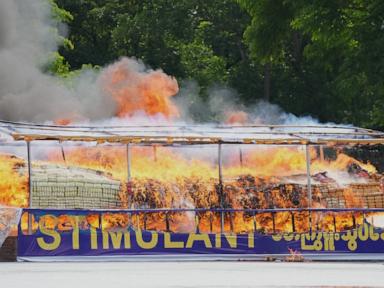
Plumes of thick black smoke blanketing the outskirts of Yangon, firefighters standing by with hoses, and rows of pristine, doused drug packages turning to ash. To mark the United Nations International Day Against Drug Abuse and Illicit Trafficking, Myanmar authorities publicly torched over $525 million worth of seized illegal drugs.
The haul was staggering. It included over 28 tonnes of methamphetamine—locally known as "ice"—alongside massive piles of heroin, opium, ketamine, and marijuana. According to Yangon anti-narcotics police officer Aung Myat Soe, the volume of narcotics slated for destruction was double what it was just a year ago.
But don't let the theatrical displays fool you. This isn't a sign that the local government is winning the war on drugs. In fact, it's proof of the exact opposite.
The reason these seizures are breaking records is that the region's drug factories are operating at an unprecedented, industrialized scale. The smoke from the Yangon incinerators is basically a smokescreen for a booming war economy that is fundamentally reshaping Southeast Asia.
The Illusion of the Half Billion Dollar Burn
When Home Affairs Minister Nyunt Win Swe addressed the state media, he laid the blame entirely on rebel factions and ethnic armed organizations. He argued that these groups exploit political instability to fund their insurgencies, directly threatening national stability.
That narrative is incredibly lopsided.
The reality on the ground is far more tangled. Since the 2021 military coup that toppled Aung San Suu Kyi's elected government, Myanmar has spiraled into an intense civil war. The breakdown of centralized governance didn't just give rebels a free pass; it created a vacuum where almost every faction involved in the conflict relies on illicit revenue to survive. Unregulated mining, massive online scam networks, and synthetic drug production are the financial lifeblood of the modern landscape.
If you look closer at the numbers, the theatrical nature of the burn becomes obvious. While the authorities burned 28 tonnes of meth, the United Nations Office on Drugs and Crime (UNODC) reports that Myanmar remains the primary source of methamphetamine for all of East and Southeast Asia. The supply is so massive that the street price of meth across the region has actually dropped over the last few years.
Basic economics tells us that if law enforcement were truly choking the supply, prices would skyrocket. Instead, the cartel laboratories are churning out product faster than authorities can track it, making these high-profile public burnings a drop in the bucket.
Industrial-Scale Jungle Labs in Shan State
To understand why a $525 million bust is minor league, you have to look at how production has evolved. We aren't talking about hidden wooden shacks in the forest anymore.
Earlier this year, a massive raid uncovered three record-sized jungle drug laboratories nestled deep in the hills of northern Shan state, roughly 180 kilometers from the Chinese border. These weren't small operations. They were the size of actual villages.
These complexes featured:
- Dedicated internal road networks to transport raw chemical precursors.
- Secluded, permanent living quarters for hundreds of workers.
- Complex, high-output power grids and dedicated water systems to keep industrial machinery running non-stop.
When teams arrived, the machines were still warm, and gas masks littered the floors from a rushed evacuation. Barrels were filled to the brim with crystal meth ready for processing. Experts estimated that just this single cluster of labs accounted for roughly a third of all the methamphetamine seized nationwide over the previous year.
Shan state sits right at the heart of the Golden Triangle—the mountainous border zone where Myanmar, Laos, and Thailand meet. It has been a smuggling hub for generations, but the shift from agricultural opium to synthetic drugs changed the game. Meth is cheap to synthesize, easy to pack, and doesn't depend on weather or harvest seasons.
A Shift in Global Narcotics Power
Something else happened when the political landscape shifted. For decades, Afghanistan was the undisputed king of global opium. But when the Taliban returned to power, they instituted a brutal, highly effective domestic crackdown on poppy cultivation.
Myanmar instantly took the top spot.
According to the UNODC, Myanmar is now the world’s largest producer of opium, alongside its status as a synthetic drug superpower. The domestic conflict provides the perfect ecosystem for this. When an ethnic armed group or a local militia takes territory from the military junta, they need cash for weapons. When the military tries to retake that territory, they use local border guard forces that are often paid through implicit permission to run illicit businesses. Everyone has a hand in the cookie jar.
Even the rebel groups aren't a monolith. Some, like the Ta'ang National Liberation Army (TNLA), have staged their own public drug burnings—destroying roughly $5.5 million in narcotics in areas under their control after securing a temporary ceasefire. They do this to project legitimacy, proving that public bonfires are a political tool used by both sides of the civil war.
What This Means for Global Security
If you think this is a localized problem contained within Southeast Asia, you're mistaken. The hyper-efficiency of the Golden Triangle supply chain directly affects global markets. The sheer volume of synthetic narcotics pouring out of Shan state flows down through Thailand, hits maritime routes via Malaysia, and ultimately reaches high-value markets in Australia, Japan, and New Zealand.
For international policy, the lesson is clear: treating this as a standard law enforcement issue is a total waste of time. You cannot arrest your way out of a drug epidemic when the production facilities are protected by heavily armed militias operating outside the reach of global law.
The international community needs to completely stop taking these state-sanctioned drug-burning ceremonies at face value. They aren't victories. They are a predictable annual ritual that obscures a deeply broken system. Until the underlying civil war is resolved and actual governance returns to the borderlands, the factories will keep running, the syndicates will keep profiting, and the smoke over Yangon will keep rising every single June.
To get a clearer picture of the sheer scale of these operations, watch this close-up report on the Golden Triangle Drug Burn showing the actual physical destruction of the seized shipments.