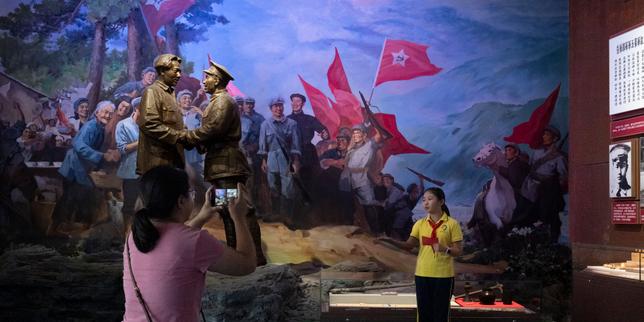
Half a century has passed since Mao Zedong drew his last breath in Beijing on September 9, 1976. Fifty years later, his face still gazes down from Tiananmen Square, watching over a nation that bears little economic resemblance to the impoverished agrarian society he left behind. You might assume that a modern global superpower, rivalling Western economies in tech and manufacturing, would have long since outgrown the shadow of an autocrat responsible for massive social devastation. You’d be wrong.
The Communist Party of China finds itself trapped in an endless ideological balancing act. On one hand, officials officially acknowledge past policy missteps. On the other hand, they treat Mao’s foundational myth as untouchable. Understanding this contradiction requires looking past official press releases and examining how political authority actually functions in Beijing today.
The Unbreakable Shield of State Legitimacy
Mao Zedong isn’t just a historical figure in China. He is the original source code of the regime's right to rule. When the People's Republic of China was proclaimed in 1949, it rewrote the country's modern trajectory. If you question the foundational narrative of the founder, you start questioning the entire system.
That is why the state narrative maintains a carefully curated split-screen view of history. Official documents credit Mao with uniting the country and kicking out foreign imperialists, while neatly sweeping the catastrophic human costs of campaigns like the Great Leap Forward and the Cultural Revolution under the rug. Xi Jinping, the current leader, has leaned heavily back into Maoist orthodoxies. Party discipline, ideological centralization, and absolute control over dissent echo the playbook of the Great Helmsman.
Echoes of the Past in Contemporary Governance
If you look at how Beijing handles dissent, controls information, and enforces ideological purity today, you'll spot direct lineages to the Maoist era. Critics often point out that while China embraced market capitalism under Deng Xiaoping, it never abandoned the authoritarian political framework built by Mao.
The suppression of political opposition, the demand for absolute loyalty from intellectuals, and the constant fear of ideological deviation didn't disappear with the introduction of skyscrapers and high-speed rail. They simply got a modern tech upgrade. Facial recognition and digital tracking replaced the neighborhood committees and Red Guard informants, but the underlying philosophy remains identical. The collective always trumps the individual. The Party always dictates the truth.
Why the Legacy Endures for Ordinary Citizens
For many everyday citizens, especially older generations or those living in poorer rural provinces, Mao represents an era of egalitarian ideals and protection against predatory foreign interests. It's easy for outside observers to focus exclusively on the political terror and economic ruin of his final decades. But in the collective memory, he also symbolizes a time when the state promised basic security and stood up to external powers.
This complicated nostalgia explains why public debates about his legacy remain tightly restricted. You can't openly analyze the darkest chapters of twentieth-century Chinese history without risking immediate censorship. The government doesn't want an open historical debate. It wants a controlled myth that keeps the current power structure safe from scrutiny.
Fifty years after his death, Mao remains the inescapable ghost in the room. China's future economic and political path depends heavily on whether future leaders can ever break free from the gravitational pull of a man who died half a century ago.
50 years since Mao's death: the heavy legacy of the Great Helmsman
This video provides an in-depth look at the enduring historical weight of Mao Zedong's governance and how his policies continue to shape modern political dynamics in China today.
http://googleusercontent.com/youtube_content/1


