When a top Chinese military strategist publicly claims that Tokyo poses a bigger threat in the South China Sea than the United States, you know the security math in Asia has fundamentally changed.
For decades, Beijing treated Washington as its primary military counterweight in contested waters. The script was predictable. American destroyers conducted freedom of navigation operations, Beijing issued formal warnings, and both sides maintained a well-rehearsed standoff. But Tokyo's aggressive entry into the maritime dispute has completely disrupted that dynamic.
At a high-level security roundtable in Hong Kong, Wu Shicun, founding president of China's National Institute for South China Sea Studies, explicitly warned that Japan’s military footprint carries a destructive potential that could eclipse American power. That isn't standard diplomatic bluster. It reveals a deep strategic anxiety inside Beijing over Tokyo’s evolving defense posture.
To understand why Chinese analysts are suddenly hyper-focused on Japanese military moves, you have to look past the usual headlines about US aircraft carriers. Japan is quietly rewriting the security map of Southeast Asia, and Beijing knows it.
What Japan Actually Did in the South China Sea
China's alarm isn't theoretical. It's grounded in concrete military actions that played out during recent joint military exercises in the region.
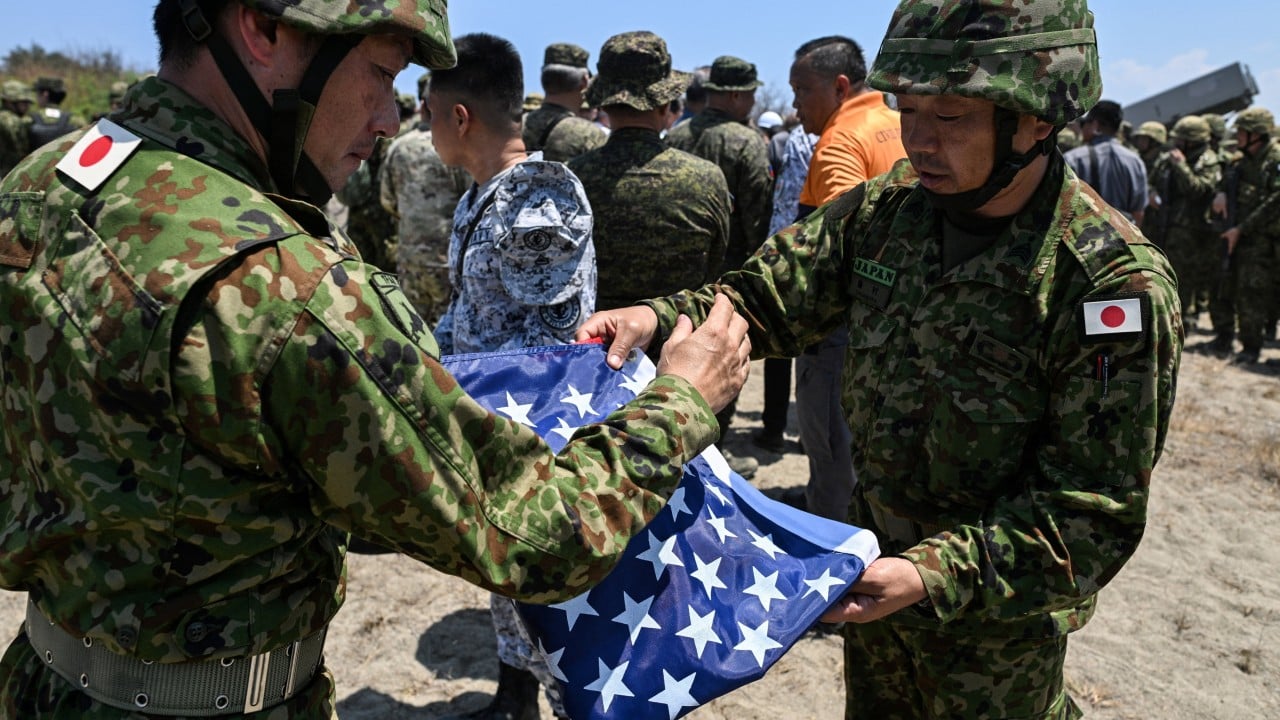
During the Balikatan exercises alongside American and Philippine forces, Tokyo didn't just send observer teams or light logistics ships. It deployed more than 1,400 personnel, three major warships, and specialized transport aircraft. More importantly, Japan conducted its first overseas live-firing of a Type 88 surface-to-ship missile system. The missile successfully struck a decommissioned Philippine Navy vessel in waters near the contested zones.
That single missile launch marked a massive shift. It was the first time since World War II that Japan demonstrated offensive anti-ship capability on foreign soil.
Beijing noticed immediately. China’s Foreign Ministry fired back, arguing that Japan is not a party to South China Sea territorial disputes and holds zero legal right to intervene. Chinese officials pointedly argued that exporting missile systems, deploying combat forces, and conducting live-fire exercises go far beyond the boundaries of self-defense outlined in Japan’s post-war pacifist constitution.
From Beijing’s perspective, an American warship in the South China Sea is a known quantity. A Japanese missile unit operating directly out of Philippine territory is a direct threat to China's operational calculus.
Why Beijing Fears Tokyo More Than the Pentagon
Why would China view Japanese military activity as potentially more dangerous than the massive power of the United States Navy? The answer comes down to geography, institutional alignment, and strategic intent.
First, Japan lives in the neighborhood. The United States operates across vast distances across the Pacific Ocean, meaning its military presence in East Asia fluctuates based on domestic political cycles in Washington and global crises elsewhere. Japan cannot pack up and leave. Tokyo's security is directly tied to the sea lines of communication passing through the Luzon Strait and the South China Sea. If those sea lanes fall under total Chinese control, Japan's economic lifeline is squeezed.
Second, Tokyo is building permanent structural alliances across Southeast Asia rather than relying purely on temporary power projection. Through defense equipment transfers, official security assistance, and radar sales, Japan is directly building up the military capacity of littoral states. Tokyo isn't just sending its own ships; it's equipping the Philippine Coast Guard and Navy with modern patrol vessels, coastal radar stations, and intelligence-sharing tools.
When Washington offers military aid, it often comes attached to complex congressional approvals and human rights conditions. Japan’s defense assistance is streamlined, practical, and tailored specifically to coastal defense. That makes Tokyo an extremely attractive defense partner for Southeast Asian nations seeking a counterweight to Chinese maritime pressure.
Third, Japan operates with a level of regional legitimacy on legal issues that frustrates Beijing. On the 10th anniversary of the landmark 2016 Hague arbitration ruling—which invalidated China’s expansive claims within its so-called nine-dash line—Japan joined a coalition of nations demanding Beijing abide by international law. When Tokyo argues for a rules-based order under the United Nations Convention on the Law of the Sea (UNCLOS), it reinforces the legal position of smaller Southeast Asian states.
History and the Ghosts of World War Two
You cannot separate Beijing's political reaction from historical memory.
When Wu Shicun described Japan's missile test as the first real flex of its military muscle since 1945, he intentionally tapped into long-standing regional history. China's political narrative heavily relies on reminding the world of Japan’s wartime past whenever Tokyo expands its defense footprint.
By framing Japan's military evolution as a return to pre-war militarism, Beijing attempts to drive a diplomatic wedge between Tokyo and its Southeast Asian neighbors. China repeatedly tells regional capitals that allowing Japanese troops onto their soil is playing with fire.
That narrative isn't hitting the way it used to.
Nations like the Philippines, Vietnam, and Malaysia view present-day maritime realities through a pragmatic lens. For Manila, daily clashes with Chinese coast guard vessels near Scarborough Shoal and Second Thomas Shoal are an immediate concern. Historical grievances from eighty years ago take a back seat when a nation needs modern maritime surveillance and anti-ship missile capacity today.
Japan’s leadership, under Prime Minister Sanae Takaichi, has recognized this shift. Tokyo no longer hides behind strict interpretations of Article 9 when regional stability is on the line. By explicitly framing South China Sea security as essential to Japan's own national survival, Tokyo has normalized its military presence in waters thousands of miles from its mainland.
The Flaw in Beijing's Maritime Strategy
Beijing expected its pressure campaign to force smaller neighbors into submission. Instead, it pushed them into the arms of a broader, more integrated coalition.
For years, China worked to keep South China Sea disputes strictly bilateral. Beijing preferred dealing with individual nations like the Philippines or Vietnam one-on-one, where its economic and military weight guaranteed overwhelming leverage. It constantly warned against the intervention of "external forces".
That strategy has backfired completely.
By pushing Manila too hard, Beijing accelerated the formation of overlapping security frameworks. Today, the Philippines coordinates defense not just with Washington, but directly with Tokyo and Canberra. Joint maritime patrols involving US, Japanese, Australian, and Philippine forces are becoming standard operational procedure in the West Philippine Sea.
Chinese strategists like Wu Shicun recognize the danger of this network. When American firepower combines with Japanese logistics, intelligence, and missile technology on Philippine soil, China faces a multi-layered defensive wall.
Beijing calls these initiatives "small cliques" that fan the flames of regional conflict. But in reality, they are a direct response to China's island-building, reef reclamation, and aggressive coast guard tactics over the past decade.
What Regional Security Looks Like Going Forward
The idea that Japan is a passive player in Asian security is dead. Tokyo has crossed the threshold from an economic powerhouse hiding behind an American security umbrella into an active military actor willing to project power across vital sea lanes.
Expect Beijing to escalate its diplomatic and economic pressure on Tokyo. China has already instituted targeted export controls against Japanese entities and increased naval patrols around the disputed Senkaku Islands (known in China as the Diaoyu Islands).
These retaliatory measures won't deter Tokyo. Japan's defense establishment has concluded that allowing China to turn the South China Sea into an internal lake is an existential threat to Japanese trade and energy imports.
If you are tracking security dynamics in East Asia, stop looking solely at Washington and Beijing. The real flashpoint to watch is the growing friction between Tokyo and Beijing over the waters of Southeast Asia.
For governments and security analysts watching the region, here are the core operational indicators to track over the coming months:
- Watch Japanese defense equipment transfers under the Official Security Assistance program, particularly radar upgrades and missile technology transfers to Manila and Hanoi.
- Track whether Japan secures a permanent or rotational troop presence in the Philippines under a Reciprocal Access Agreement, which would allow seamless military deployments.
- Observe how China recalibrates its coast guard operations near Scarborough Shoal and the Spratly Islands when Japanese warships are operating in adjacent corridors.