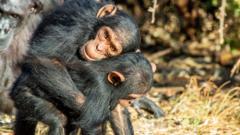
When a group of chimps or bonobos knows a bowl of food is coming, things can get tense fast. Resources are limited. Tempers flare. Yet, right before food gets thrown into an enclosure, something unexpected happens. The animals don't just bare their teeth or prepare to fight. They embrace. They squeeze each other tightly, press their lips together in a kiss, hold hands, or even stick a finger directly into another ape's mouth.
If you thought primates only hug each other after a brutal fight to make up, think again.
A breakthrough study published in Proceedings of the Royal Society B: Biological Sciences reveals that great apes actively use physical touch to prevent conflicts before they even start. Instead of acting merely as a post-fight band-aid, friendly contact acts as a proactive diplomatic tool. It calms group jitters, builds temporary trust, and ensures everyone gets a fair turn at the dinner table.
Honestly, it turns out our closest living animal relatives have a surprisingly sophisticated love language for handling stress.
What Primatologists Actually Saw in African Sanctuaries
For decades, behavioral scientists focused almost entirely on post-conflict reconciliation. If two adult male chimps went toe-to-toe over a spot in the shade, researchers tracked how long it took for them to groom each other afterward. That post-fight grooming was seen as the main mechanism for maintaining social order.
A team led by Dr. Jake Brooker and Professor Zanna Clay from Durham University decided to test a different hypothesis. They wondered whether physical contact could prevent fights from breaking out in the first place.
To test this, researchers observed five semi-wild groups of bonobos and chimpanzees living in two major African wildlife sanctuaries:
- Lola ya Bonobo Sanctuary in the Democratic Republic of Congo, home to rescued bonobos.
- Chimfunshi Wildlife Orphanage Trust in Zambia, one of the largest chimpanzee sanctuaries on Earth.
The researchers set up a high-stakes scenario. They filmed what happened right before, during, and after offering the animals a prized, limited treat: peanuts.
Peanuts create instant social pressure. There are never enough peanuts for every individual to get a bellyful at once. Naturally, the arrival of the treats raised anxiety levels across every group. But instead of immediate chaotic brawling, the cameras caught a flurry of affectionate physical contact.
The Peanuts Test and How Touch Changes Everything
When the apes realized peanut feeding time was approaching, they began reaching out to one another. They exchanged quick mouth-to-mouth kisses, threw their arms around each other's shoulders, patted backs, and held hands.
The statistical results were crystal clear.
Individuals who engaged in more reassuring touch right before the competitive feeding session spent significantly more time co-feeding peacefully alongside their peers. Touch directly boosted social tolerance. The apes who hugged before the food arrived were far less likely to swat at each other or hoard all the snacks.
That pattern held true for both chimpanzees and bonobos.
That finding surprised plenty of people. Popular science often paints chimpanzees as violent, aggressive warmongers and bonobos as peaceful, hippie-like pacifists. But this data shows that both species possess the exact same diplomatic toolkit for calming nervous energy and sharing resources.
Different Social Structures, Same Need for Reassurance
While both species used touch to keep the peace, the key players differed based on how their societies function.
In bonobo groups, female alliances run the show. Female bonobos band together to keep dominant males in check and maintain stability. Unsurprisingly, the strongest effect of pre-feeding physical touch in bonobos occurred between female-female pairs. Two females who shared an embrace or a quick mouth contact before feeding were far more likely to sit side-by-side and munch on peanuts without drama.
Chimpanzees operate on a totally different wavelength. Male chimps form powerful political coalitions to maintain rank and protect territory. Among the chimpanzees at Chimfunshi, the pre-feeding touch effect was strongest between male-male pairs. High-ranking and mid-ranking males used touch to reassure one another before diving into the food pile.
Despite these social differences, the underlying function remained identical across species. Friendly physical contact lowers the immediate perception of threat. It signals good intentions when competition looms.
The Reassurance Train and Extreme Displays of Trust
Some of the physical touches recorded by the research team went way beyond a simple hug or quick pat on the back.
In the most socially tolerant chimp group, researchers observed what Dr. Brooker called a "reassurance train." One male embraced another from behind. A second male joined in, hugging the first, and then a third joined, forming an unbroken chain of physical contact that settled the whole group down right before feeding.
Then there were the riskier behaviors.
Chimpanzees were filmed placing their hands or fingers directly inside another chimp's mouth. Think about that for a second. A chimpanzee has immensely powerful jaws capable of inflicting severe injuries. Willingly shoving your fingers into another ape's mouth—or allowing them to do it to you—requires an extraordinary level of vulnerability.
That vulnerability is the entire point. By allowing a risky physical touch, the apes send an undeniable signal: I trust you, and I know you won't harm me right now.
These acts occurred far more frequently in groups that already possessed high levels of baseline social tolerance. Trust isn't built out of nowhere; it's maintained through constant, low-stakes physical interactions that prove nobody is about to snap.
An Evolutionary Tool Shared for Millions of Years
This behavior isn't just a quirky habit learned by sanctuary animals. Because both chimpanzees and bonobos rely on pre-competition touch, scientists estimate this trait evolved in a shared common ancestor at least six million years ago.
That means long before modern humans built cities, wrote laws, or sat down at negotiation tables, our early ancestors were using physical touch to manage group anxiety and split up gathered food.
In human evolution, touch served as the original social glue. Physical contact releases oxytocin, lowers heart rates, and drops cortisol levels in both the person giving the touch and the person receiving it. It's a biological system designed to override the fight-or-flight response when cooperative action is needed.
What Humans Get Wrong About Handling Group Tension
Human beings often rely almost exclusively on verbal communication to resolve tension. We try to talk through awkward situations, explain away anxiety, or draft rules to govern fair behavior.
Yet, words often fail when underlying anxiety is running high.
Before a high-pressure sporting event, a tense business negotiation, or a difficult family meeting, verbal reassuring statements can sometimes sound hollow or insincere. Physical touch operates on a deeper, pre-verbal channel.
Consider how human athletes behave before a major game. They high-five, bump chests, pat backs, and huddle tight. That isn't just theatrical hype. It's the human version of the ape reassurance train. It lowers physiological stress and builds instant social cohesion right before a high-stakes challenge.
When people drop physical closeness during times of stress, friction spikes. Groups that stop offering small physical gestures of reassurance tend to break down into infighting much faster when resources or time run tight.
Practical Ways to Apply Pre-Stress Reassurance in Real Life
You don't need to go around sticking your fingers in your colleagues' mouths to benefit from this evolutionary mechanism. But you can start using physical reassurance to manage group tension in daily scenarios.
- Reset team energy before high-stakes moments. If your team is about to walk into a tough presentation or a tight deadline, don't just review slides. A firm hand-shake, a pat on the shoulder, or a group huddle physically calms nervous systems far faster than a pep talk.
- Use warm physical touch with family during stressful transitions. Getting kids out the door in the morning or handling a chaotic holiday dinner creates friction. A quick hug or a hand on the shoulder before things get chaotic sets a calm baseline.
- Recognize pre-competition anxiety early. When you notice people in your group acting jumpy or defensive because resources (like time, recognition, or budget) are limited, don't wait for a fight to break out. Offer immediate, grounded signals of reassurance to defuse tension early.
Physical touch remains one of the simplest, most potent tools for keeping the peace. It worked for our primate ancestors six million years ago, and it still works today.