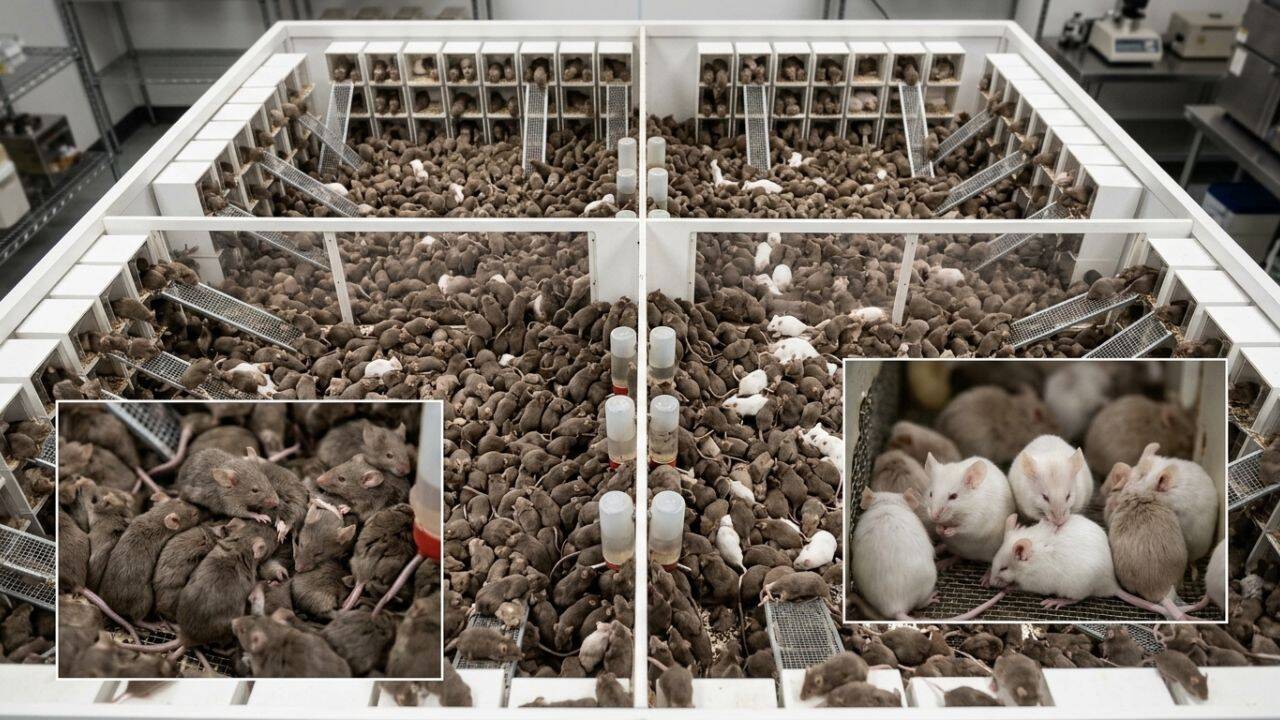
In the summer of 1968, a researcher named John B. Calhoun placed four pairs of healthy albino mice into a custom-built metal pen at a laboratory in Maryland.
The enclosure, dubbed Universe 25, was a rodent utopia. It featured unlimited food, clean water, hundreds of comfortable nesting boxes, and a climate-controlled atmosphere. It was completely free of predators and infectious diseases. The space could easily accommodate several thousand mice.
Yet, within five years, every single inhabitant was dead. The colony peaked at 2,200 mice and then suffered a spectacular, bizarre social collapse that wiped them out entirely.
For decades, the standard telling of John Calhoun's Universe 25 mouse experiment has been used as a dark warning about human overpopulation. Media outlets, politicians, and science fiction writers grabbed onto the study to argue that crowded modern cities would inevitably descend into violent, sterile chaos.
But that popular narrative is almost entirely wrong.
When you look closely at Calhoun's actual data, his personal notes, and modern sociological reviews, a different story emerges. The tragedy of Universe 25 was not caused by simple overpopulation. It was caused by social inequality, poor spatial design, and a loss of meaningful purpose.
Here is what really happened inside that metal cage, and why it still matters today.
Inside the Metal Eden
Calhoun did not just throw some mice in a box and watch them fight. He spent years designing a 9-foot-square enclosure divided into sixteen identical corridors, each equipped with feeding stations, drinking tubes, and vertical nesting boxes. He officially called it the Mortality-Inhibiting Environment for Mice.
The early days of the experiment were peaceful. The eight founding mice quickly realized they had landed in paradise. They ate, slept, and bred.
During this initial phase, the population doubled roughly every 55 days. By day 315, the enclosure held more than 600 mice.
Then, the first cracks in the social structure appeared.
The Rise of the Social Dropouts
In a natural setting, when a mouse colony grows too large, younger mice leave to colonize new territories. Universe 25 had no exit.
As healthy young mice survived to adulthood in unprecedented numbers, they flooded the social market. The older, dominant mice held onto their territories and breeding rights, leaving the younger generation with no defined social roles to fill.
Without a purpose, these young displaced males withdrew socially. They gathered in the center of the pen, passive and listless. But their passivity would occasionally erupt into horrific, unpredictable violence. They attacked each other without provocation, leaving many covered in bite marks and scar tissue.
The Beautiful Ones
At the other extreme of this social breakdown was a group Calhoun called the beautiful ones.
These were young males who avoided all conflict, competition, and social interaction. They spent their entire day eating, sleeping, and meticulously grooming themselves. They had pristine coats, but they lacked any social skills. They completely ignored the females and had no interest in mating.
They had physically survived, but they had suffered what Calhoun called a spiritual death.
The Illusion of Resource Abundance
The most common mistake people make when reading about Universe 25 is assuming that density alone killed the colony.
The physical space was built to comfortably house 4,000 mice. The population peaked at 2,200, meaning the cage was never even close to being physically full.
Instead, the real killer was the terrible distribution of resources.
A few highly aggressive, dominant males occupied the prime nesting boxes near the food sources. They guarded these territories fiercely, hoarding the best spots and forcing the rest of the population to crowd into the remaining, less desirable spaces.
Because of this uneven distribution, the vast majority of the mice experienced extreme overcrowding, while a tiny elite lived in spacious luxury. It was a crisis of wealth inequality, not resource scarcity.
The constant stress of defending territories broke the dominant males' spirits. Eventually, they stopped defending their nests altogether. Mothers, left to fend for themselves, became hyper-aggressive. They attacked intruders, but they also turned on their own pups, kicking them out of the nest too early or abandoning them entirely.
Once social behaviors broke down completely, the birth rate dropped to zero. Even when Calhoun took some of the "beautiful ones" out of the cage and placed them with normal, healthy mice, they had forgotten how to socialize. They had lost the capacity to survive as social creatures.
What the Doomsday Prophets Missed
In the 1970s, the public was terrified of overpopulation. Books like Paul Ehrlich's The Population Bomb warned that human society was on the brink of collapse due to overcrowding.
Calhoun's mice became the perfect poster child for these fears. Media reports claimed that cities like New York and Tokyo would soon experience their own behavioral sinks, filled with isolated, grooming individuals and sudden bursts of senseless violence.
But humans are not mice.
Decades of research after Calhoun's death show that high density does not automatically cause social pathology in humans. Many of the world's most densely populated cities, such as Tokyo, have remarkably low crime rates and high life expectancies.
Why? Because humans possess culture, technology, and the ability to organize space and resources far more effectively than rodents. We can build institutions, establish laws, and create social roles to manage crowding.
Furthermore, later researchers pointed out several major flaws in Calhoun's methodology. The enclosure was only cleaned every few weeks, meaning the environment likely suffered from subtle disease and pest build-up that influenced the mice's behavior.
Calhoun's Real, Forgotten Mission
Here is the twist that almost everyone forgets. Calhoun was not actually a doomer.
He did not spend the rest of his life warning about the end of the world. He spent it trying to design spaces that would prevent the very collapse he witnessed.
Calhoun believed that physical crowding could be overcome if we designed our environments better. In his later experiments, he modified the enclosures, adding more rooms and barriers to allow animals to avoid unwanted contact. The negative social behaviors disappeared.
He argued that as physical space shrinks, humans must expand into conceptual space. He called this ideational generativity. By creating new ideas, technologies, and social roles, we can bypass the limits of physical space.
Practical Lessons for the Modern Era
If we look at Universe 25 through a modern lens, the takeaway is not about breeding less. It is about how we build our communities and workplaces.
- Space design matters more than square footage. Simply putting people in an open-plan office or a dense apartment block without private, quiet areas causes the same psychological exhaustion the mice faced. We need spaces designed for control over social interaction.
- Resource distribution determines stability. When a small group hoards the prime spaces and resources, the resulting pressure on the rest of the community creates chaos, even when there is technically enough to go around.
- Meaningful roles prevent isolation. When young people feel there is no room for them to build a life, establish identity, or contribute to society, they withdraw into virtual bubbles. The rise of extreme modern isolation mirrors the behavioral retreat of the beautiful ones.
Designing societies with shared, equitable access to space, resources, and purpose is the only way to avoid our own behavioral sink.
For a deeper look into Calhoun's work and his attempts to solve these social dilemmas, watch The Calhoun Effect video. This video does an excellent job of explaining Calhoun's later years and why he believed human creativity could save us from the fate of his mice.