The Middle East is on the brink of an all-out regional war, and the window to prevent a global economic shockwave is closing fast. Overnight, the skies above southern Iran turned into a theater of fire. US Central Command orchestrated a massive five-hour wave of precision air and sea strikes targeting multiple strategic nodes. Explosions rocked the critical port city of Bandar Abbas, sent shockwaves through the nearby Qeshm Island, and rattled coastal defenses all the way up to Bushehr.
This isn't just another brief exchange of cross-border fire. This is a dramatic escalation that effectively redraws the security dynamics of international shipping. Washington is attempting to forcibly reshape the rules of engagement in the Strait of Hormuz. If you think this is a localized conflict that won't touch your daily life, you're missing the bigger picture.
The Sudden Reality of the New Conflict in Iran
Tensions don't simmer anymore. They explode. On July 14, 2026, the long-predicted confrontation between Washington and Tehran reached a boiling point when CENTCOM deployed targeted ordnance across six distinct coastal installations. The operation finished late in the evening, leaving a trail of destroyed radar arrays, disabled surface-to-air missile batteries, and crippled drone launch pads along the Iranian shoreline.
The primary logic behind the strikes centers on maritime security. Washington claims these actions are direct retributions meant to degrade Iran's capacity to threaten commercial shipping lanes. Over the preceding days, several tankers reported mysterious hull damage and projectile strikes within the narrow choke point of the Strait of Hormuz. The White House decided that a passive containment strategy was no longer viable.
By targeting Bushehr, Chah Bahar, Jask, Konarak, Abu Musa, and Bandar Abbas, the military campaign aims to strip away the Islamic Revolutionary Guard Corps' ability to project asymmetric naval power. This represents a direct challenge to Tehran's sovereignty. The response from the ground inside Iran reveals a population gripped by fear, dealing with immediate infrastructural vulnerabilities alongside the threat of incoming tonnage.
What Actually Happened Near Bandar Abbas and Qeshm Island
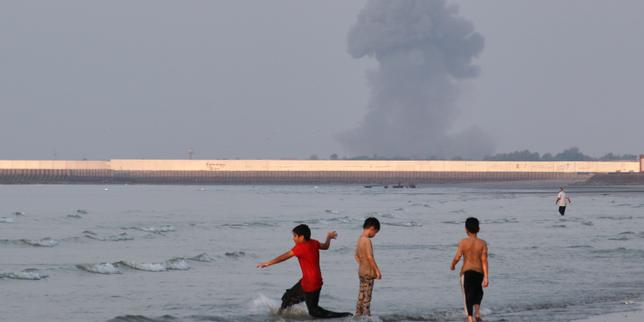
Local accounts from the ground describe back-to-back detonations that rattled windows and shook foundations for miles. In the strategic port city of Bandar Abbas, the focus of the attack was a vital submarine and ship maintenance facility. CENTCOM confirmed using one-way attack surface drones, hitting the naval base directly and sending thick plumes of black smoke into the night sky.
Just off the coast, Qeshm Island faced its own barrage. Local officials confirmed that projectiles struck military positions around 19:00 local time, illuminating the island's coastal bluffs. The island sits like a sentinel right at the throat of the Strait of Hormuz. For years, it has served as a primary staging ground for Iranian fast-attack craft and coastal surveillance systems. By blinding the radar networks on Qeshm, the US military effectively created a blind spot in Iran's maritime awareness.
The human cost is starting to compound. Coastal communities in the southern regions are already facing deep structural strains. Previous strikes damaged municipal water storage facilities, leaving over 20,000 civilians rationing clean water in mid-summer temperatures that routinely top 45 degrees Celsius. The psychological toll on these communities is immense. Families are forced to stay glued to state media updates, wondering if the next blast will hit civilian infrastructure.
Tracking the Strategic Targets From Bushehr to Chah Bahar
To understand the scope of this air campaign, look at the geography. This wasn't a localized pinprick. It was a synchronized sweep across an entire coastline stretching hundreds of miles.
- Bushehr: The inclusion of this northern port city caused immediate international alarm. Bushehr hosts Iran's only civilian nuclear power plant. While US officials explicitly stated that the target list avoided nuclear infrastructure, striking military sites within the same municipality sends an unmissable message.
- Chah Bahar and Konarak: Located far to the east near the Pakistani border, these twin ports represent Iran's window to the Indian Ocean. Hitting them ensures that the IRGC cannot easily relocate its naval assets outside the immediate confines of the Persian Gulf.
- Jask and Sirik: These secondary ports serve as alternative logistics bases. Sirik had already seen its surrounding infrastructure hit during earlier exchanges, creating severe bottlenecks for localized supply lines.
- Abu Musa: A disputed island in the middle of the Gulf. It acts as an unsinkable aircraft carrier for Iranian anti-ship cruise missiles. Neutralizing its launch pads is essential for any conventional navy trying to secure the surrounding waters.
Tehran isn't taking these losses quietly. The IRGC retaliated with a series of targeted missile and drone strikes against regional targets. In Bahrain, Iranian munitions targeted a Patriot missile radar array and an air control facility used by the US Navy's Fifth Fleet. Concurrently, a Norwegian-flagged tanker, the Stolt Magnesium, was struck by a rogue projectile while transiting the Arabian Sea near Oman. The maritime war has expanded beyond the Gulf.
Why a Naval Blockade Risks Global Energy Panic
The military strikes are only half the story. The true economic catalyst is the political declaration that accompanied them. The White House announced the reimposition of a strict naval blockade against Iranian shipping. The goal is simple on paper: restrict every single drop of maritime traffic entering or exiting Iranian ports.
Implementing a blockade in one of the most heavily trafficked maritime corridors on Earth is an incredibly risky gamble. The Strait of Hormuz sees roughly one-fifth of the world's total petroleum liquid consumption pass through its waters daily. It's an economic artery. If you squeeze it too hard, the entire global market suffocates.
Earlier policy proposals floated the idea of charging a 20 percent toll fee on commercial vessels passing through the strait, ostensibly to cover the costs of American naval protection. While political figures have recently shifted their public posture away from these specific tolls toward broader trade agreements with Gulf allies, the mere mention of such measures threw international shipping syndicates into chaos. Shipowners don't want to pay protection money, and they certainly don't want their vessels caught in an active crossfire between superpower navies and regional missile batteries.
The Real Fallout for Shipping Lanes and Oil Markets
The financial system reacted with predictable volatility. Oil markets reacted instantly to the news of the five-hour strike wave. Brent crude prices surged by more than 9 percent in a single trading session, marking one of the most violent single-day spikes seen in years.
This sudden surge creates an immediate headache for global central banks. For months, economists have warned that inflation indicators remain highly sensitive to energy shocks. A sustained disruption in the Gulf could force monetary authorities to keep interest rates elevated for a longer period, dampening global economic growth projections for the rest of 2026.
Insurance underwriters are already rewriting policies for vessels entering the region. War risk premiums are skyrocketing. Some maritime transport firms are choosing to bypass the region entirely, opting for lengthy, expensive detours around the Cape of Good Hope. This choice adds weeks to transit schedules, delays supply chains, and drives up the baseline cost of consumer goods worldwide. It's a domino effect that starts with an explosion in Bandar Abbas and ends with higher prices at your local gas station.
Moving Forward Amid Rising Geopolitical Friction
The situation remains highly fluid, and traditional diplomatic channels are struggling to find traction. The United Nations human rights apparatus called the resumption of hostilities a massive setback for civilian safety, urging both sides to display immediate tactical restraint. However, restraint is a rare commodity in the current political climate.
If you are trying to navigate the practical fallout of this escalating crisis, you need to watch specific indicators over the coming days. Don't get distracted by the daily political rhetoric. Focus on the hard operational shifts on the water.
First, track the enforcement mechanism of the US blockade. If American warships begin physically boarding or redirecting commercial vessels bound for Iranian ports, the likelihood of a direct naval engagement increases exponentially. Watch how third-party shipping hubs like Dubai or Singapore react to these enforcement measures.
Second, monitor the operational status of alternative transit routes. The ability of global supply lines to absorb this shock depends heavily on whether neighboring countries can ramp up pipeline capacities to bypass the Strait of Hormuz entirely.
The coming weeks will determine whether this confrontation settles into a managed crisis or devolves into an uncontained regional conflagration. The stakes couldn't be higher, and the margin for error has completely vanished.