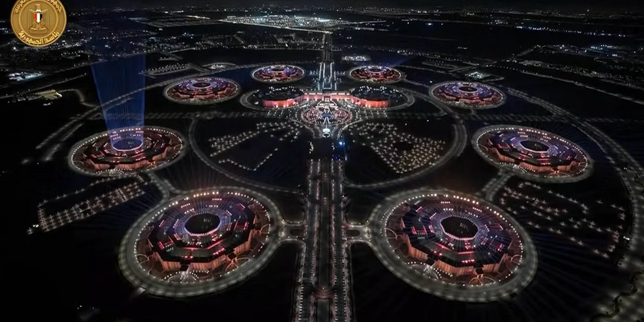
You can see it from miles away across the barren Egyptian desert, a massive geometric footprint rising out of the sand like an ancient monument built for the twenty-first century. It's called the Octagon. Located about fifty kilometers east of Cairo inside the sprawling New Administrative Capital, this military complex spans roughly 92 square kilometers. President Abdel Fattah al-Sisi officially inaugurated the site, creating a colossal hub designed to house every single branch of the nation's armed forces and security institutions under one roof.
Critics call it a monument to an isolated regime. Supporters view it as the ultimate brain of a modern state. But beneath the concrete and glass lies a stark reality about how modern authoritarian power secures its future far away from the crowded streets of downtown Cairo.
The Architecture of Absolute Control
Most people think military bases are just about barracks and tanks. They're wrong. The Octagon is a statement of political survival. Composed of eight distinct octagonal buildings arranged in a precise circle, the layout mirrors the Pentagon in the United States but dwarfs it in sheer land coverage.
Egypt spent billions constructing this mega-complex while the country wrestled with severe economic pressures, inflation, and currency devaluation. Why? Because centralizing power is worth any price to a regime that remembers the tremors of the 2011 revolution. By moving the military command center forty miles away from the historical center of Cairo, the leadership insulates itself from public protest, urban unrest, and civilian oversight. You can't march on a headquarters lost in the empty desert dunes.
Moving Past the Age of Mass Armies
For decades, Egypt's military strength relied on sheer numbers. Huge infantry divisions, thousands of armored vehicles, and large fleets of fighter jets defined its posture. Modern warfare doesn't care about sheer mass if your command chain is slow.
The Octagon represents a desperate pivot toward data-driven defense. The complex integrates advanced communication networks, artificial intelligence analytics, and secure real-time intelligence sharing. Regional instability surrounds Egypt on multiple fronts. Sudan burns to the south, Libya remains fractured to the west, and the Gaza conflict simmers right on the northeastern border. In this volatile neighborhood, Cairo wants a hyper-connected nervous system that processes battlefield threats instantly.
Yet, technology here serves a dual purpose. The same secure networks and AI-driven monitoring systems used to track external threats double as tools for internal security and total state surveillance.
The Economy Inside the Citadel
You cannot separate Egypt's military expansion from its business empire. The armed forces don't just fight wars; they pave roads, bake bread, build cities, and manufacture consumer goods. The New Administrative Capital itself is heavily driven by military engineering bodies.
Pouring state resources into desert megaprojects creates a closed economic loop. The military acts as contractor, architect, and ultimate beneficiary. While everyday citizens face soaring living costs and tightening economic constraints, the state prioritizes concrete fortresses and high-tech command centers. It's an investment in regime continuity disguised as national security modernization.
What the Megaproject Really Means
The Octagon isn't just a building. It's a physical manifestation of how political power intends to survive the coming decades. When you build the largest defense headquarters on earth in the middle of nowhere, you aren't just preparing for foreign adversaries. You are drawing a hard line between the rulers and the ruled.
The sand will keep blowing, but the fortress is here to stay.