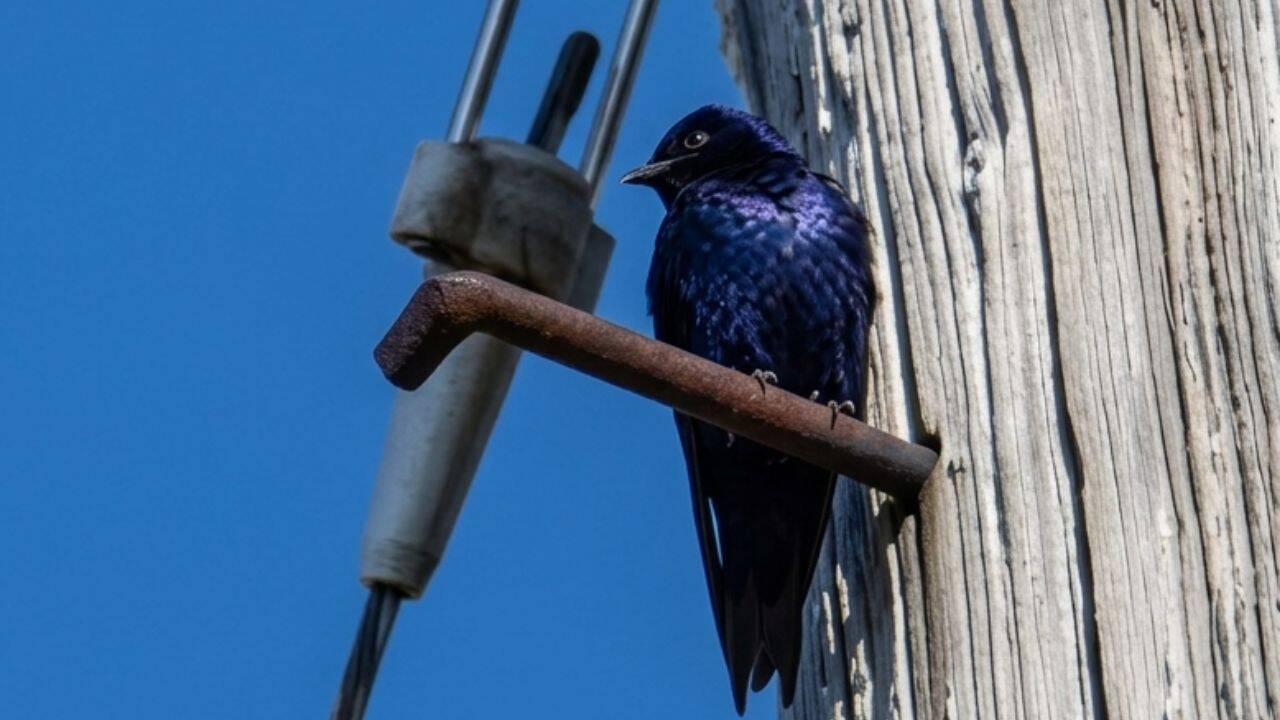
When work crews rolled into the Sierra Azul Open Space Preserve to restore roughly 40 acres of newly acquired land, they brought heavy machinery with one clear objective: strip away decades of human neglect. Over 900,000 pounds of human debris vanished from the hillsides. Abandoned vehicles, crumbling outbuildings, toxic lead and asbestos construction waste, and derelict septic systems were hauled away to protect the local watershed.
Yet, amid the massive sanitization effort, crews deliberately left old telephone poles standing upright in the dirt.
It wasn't an oversight. It was a calculated ecological intervention for a rare resident making a fragile comeback: the western purple martin.
The Mystery of the Missing Martins
For years, local biologists assumed the western subspecies of the purple martin (Progne subis arboricola) had basically vanished from Santa Clara County. Urban encroachment, loss of mature forests, and intense competition from nonnative European starlings had driven the birds out of their historical ranges. European starlings are aggressive cavity-nesters. They routinely outcompete native birds for natural tree hollows, pushing species like the western purple martin toward local extinction.
Then, field staff working on nearby Mount Umunhum stumbled upon something unexpected. They spotted purple martins nesting inside holes of aging wooden utility poles near the mountain top.
That single observation changed the playbook for the Midpeninsula Regional Open Space District. Unlike their eastern cousins—which happily occupy manufactured human birdhouses and apartment-style gourds—western purple martins are picky. They heavily favor natural cavities, particularly in standing dead trees or snags. When those trees disappear, the birds lose their nurseries.
Learning What the Birds Actually Want
Restoring wildlife habitat isn't just about planting wildflowers and walking away. It requires understanding niche biological demands.
When Midpen initially confirmed the birds were trying to claw back a foothold in Sierra Azul, conservationists launched a multiyear monitoring program. Their first instinct was to ship in standard nest boxes that had successfully lured purple martins in Washington and Oregon. The birds ignored them completely.
Box-style designs failed to trigger the natural nesting triggers of the western subspecies. So, researchers went back to the drawing board. They engineered custom hollowed wooden poles designed to replicate the exact dimensions, entrance-hole sizes, and ground-clearance heights found in natural tree cavities and utility poles.
By 2022, those custom structures finally produced results, confirming the first successful nesting pairs in the new designs. But when it came to actual field restoration on newly acquired open space parcels, why invent a wooden pole when a weather-worn telephone pole is already doing the job?
Debris Removal Meets Wildlife Architecture
Capital Project Manager Ayden Sabharwal and his team faced a delicate balancing act. Land restoration projects often lean toward sterile perfection. Bulldozers grade slopes back to original pre-development drainage patterns, hand-seeding spreads weed-free straw, and old human footprints are scrubbed clean.
Leaving decaying industrial timber on newly cleaned land goes against standard landscaping aesthetics. But ignoring the ecological reality of what endangered birds use for survival spells disaster for conservation.
By sparing those weathered telephone poles from the scrap heap, the district gave migratory birds an immediate, ready-made nesting infrastructure while surrounding chaparral and native forests slowly recover. These migratory flyers spend their winters thousands of miles away in South America before returning north each summer to breed. When they arrive, they need immediate access to nesting sites and rich insect populations overhead. Standing timber provides the exact vertical elevation and cavity protection they need while evading aggressive starlings.
As the region weaves these restored parcels into the larger planned Umunhum-to-the-Sea regional trail corridor, the project proves that smart land stewardship requires more than just hauling away trash. Sometimes, the best thing you can do for nature is leave the right piece of junk standing.