If you think the next great war will be fought over microchips or deep-sea data cables, you are looking too low. Look up. The sky above us is quietly turning into a high-stakes arena of state-sponsored manipulation.
For decades, messing with the weather was the stuff of fringe conspiracy theories or minor agricultural adjustments. Not anymore. Right now, major powers are scaling up atmospheric intervention technologies at a pace that far outstrips international law. When a nation alters its skies to combat domestic droughts or heatwaves, it does not happen in a vacuum. Air moves. Clouds drift. What looks like a brilliant climate adaptation strategy to one country looks exactly like resource theft or a hostile act to its neighbor.
The reality is stark: whoever controls the rain controls the regional food supply, energy grids, and tactical military advantages. We have entered an era where the climate itself is a theatre of geopolitical competition, and the global rules meant to police it are dangerously out of date.
The Rain Stealing Accusations Are Already Here
This isn't a projection about the distant future. The friction points are visible today. Consider the growing anxiety in the Middle East and parts of Asia. When the United Arab Emirates and Saudi Arabia aggressively scale up rain-making operations to secure their reservoirs, they share the same atmospheric currents. The moment a cloud-seeding operation succeeds in dropping rain over one territory, neighbors downwind naturally begin to wonder if their own moisture was intercepted.
Iran has openly accused rivals of manipulating the skies to worsen its severe droughts. While attributing specific meteorological shifts to a localized cloud-seeding flight remains incredibly complex, the political damage is done. In geopolitics, perception operates as reality. If a nation believes its water security is being compromised by a neighbor’s atmospheric program, the line between an environmental dispute and a security crisis disappears.
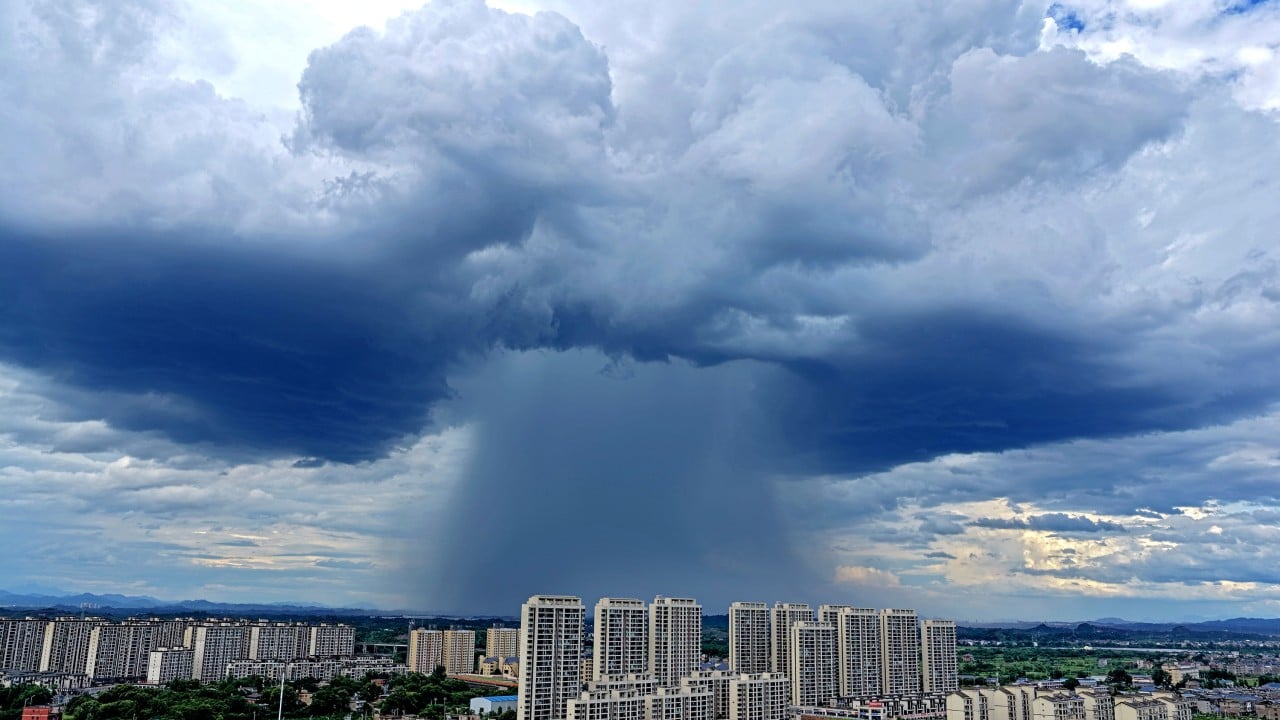
Then look at Asia. Beijing has committed to an aggressive, large-scale weather modification program, targeting control over massive swaths of its territory. The scale is unprecedented, involving thousands of specialized rocket launchers and artillery shells packed with silver iodide to force precipitation over critical farming belts. But this massive intervention occurs right above the source waters of major international rivers.
For India, this isn't just an domestic policy quirk; it is a strategic threat. The Tibetan Plateau serves as the water tower for hundreds of millions of people downstream. If massive weather modification projects trap monsoon rains upstream to feed dry northern Chinese basins, the flow of rivers like the Brahmaputra becomes unpredictable. You don't need to drop bombs to destabilize a rival when you can simply alter the flow of their water supply from the clouds.
From Cloud Seeding to Plan B Geoengineering
The tools we are talking about go far beyond basic rain-making. As the planetary thermostat continues to rise, the conversation is shifting toward large-scale geoengineering. What used to be discussed as a radical "Plan B" to counter global warming is getting serious funding and research.
The most discussed technique is Stratospheric Aerosol Injection (SAI). The idea mimics the global cooling effect seen after massive volcanic eruptions. By flying high-altitude aircraft into the stratosphere and dispersing reflective particles—like sulfur dioxide—scientists can bounce a fraction of solar radiation back into space. It sounds like a neat fix to temporarily lower global temperatures, reduce heat-related deaths, and protect fragile ecosystems.
But the strategic risks are terrifying. SAI cannot be perfectly localized. If one country decides unilaterally to deploy solar geoengineering to save its own crops, the sudden shift in atmospheric composition will alter global weather systems. A computer model might show cooling in North America, but that same model might predict a catastrophic failure of the South Asian monsoon or severe droughts across the African continent.
Who gets to hold the global thermostat? If a unilateral deployment triggers a famine on the other side of the planet, that action shifts from an environmental experiment to an act of war.
The Flaw in the Global Rulebook
We technically have a treaty designed to stop this. The Convention on the Prohibition of Military or Any Other Hostile Use of Environmental Modification Techniques—better known as the ENMOD treaty—was created in the late 1970s. It was hammered out during the Cold War after the public learned about Operation Popeye, a covert US military operation during the Vietnam War. For five years, the US Air Force seeded clouds over the Ho Chi Minh trail to deliberately prolong the monsoon season, turning supply lines into impassable mud tracks.
ENMOD explicitly bans any hostile use of environmental modification that has widespread, long-lasting, or severe effects. But the treaty has a massive, glaring loophole: it permits the use of these exact same technologies for peaceful purposes.
ENMOD Treaty Paradox:
Hostile Intent = Banned Eco-Weapon
Peaceful Intent = Permitted Climate Adaptation
Here is the problem. In a warming world, every major power will frame its atmospheric manipulation as a peaceful, defensive act of climate adaptation. If a country uses ionospheric radars or massive cloud-seeding arrays to protect its own grid or boost its agricultural yield, it is fully legal under ENMOD. Yet, the physical consequences downwind remain identical to an offensive strike.
Furthermore, proving intent in the atmosphere is next to impossible. If a country suffers a flash flood or a prolonged drought right after a rival launches a massive atmospheric initiative, proving the disaster was engineered rather than natural is a scientific nightmare. This ambiguity provides perfect deniability, making the sky an incredibly attractive arena for gray-zone coercion.
The Real Next Steps for Security Teams
We cannot afford to treat atmospheric tech as a distant science fiction problem. Security analysts, regional policy experts, and environmental strategists must adapt immediately. If you are analyzing regional stability, here is what needs to happen right now:
- Build Transboundary Transparency Frameworks: Do not wait for a global UN consensus. Bordering nations must establish bilateral registries for all weather modification flights. Knowing exactly who is seeding where, and when, prevents the dangerous guesswork that fuels military escalation.
- Invest in Independent Atmospheric Attribution: Countries need to develop advanced meteorological modeling explicitly designed to track the downwind footprint of artificial precipitation. You cannot defend against resource theft if you cannot prove it is happening.
- Update the Security Calculus: Regional security briefs must stop treating weather as a fixed background variable. Changes in rainfall patterns patterns along contested borders should be analyzed alongside troop movements and infrastructure builds.
The atmosphere is no longer just the background environment where geopolitics plays out. It has actively become the asset, the infrastructure, and the leverage. If we do not establish clear, enforceable rules on who commands the sky, the next conflict will not be sparked by what happens on the ground, but by what we choose to pull out of the clouds.